



One of the most overwhelming aspects of being an art teacher is managing all the artwork.
Of course, you don’t have to manage it at all; children can take their art with them when they leave class. But for me, I like to keep all of the art created in the art room in the art room.
There’s a reason for my managing madness: Art Shows.
Each spring there are a medley of opportunities to showcase the student’s art, starting with the biggest, the school art show.
Each child gets to display one piece. I like to have all pieces available in individual portfolios in order to select the student’s best one. Also, this system gives me the opportunity to select a variety of artwork so the parents can see all of the projects done throughout the year. You can read more about how I prep for my art show here.
Creating Student Portfolios

At the beginning of the year, I take a 18″ x 24″ piece of sulphite paper (I use whatever color I have, but color coding would be cool!), fold it in half then:
– Write the student’s name
– Write the teacher’s last name or room number
– Write the grade level
– If that class has inclusion students, I like to put an asterisk next to those children’s names, because even though they attend art with this class, their artwork is grouped with the inclusion classes for the art show.
Portfolio Storage
So, now that you have a portfolio for each child, where do you put them?
At one of my schools, I have this nifty cubicle shelf. It’s old and wooden and the perfect size for holding a classroom’s stack of portfolios. By chance, this shelf has 5 cubes per row. Perfect, since I teach five classes in one day.
I put a label at the very top of each row: Monday Group A, Friday Group A, Monday Group B and Friday Group B.
As you may have determined, I teach in cycles: Group A for 5 weeks, then Group B for 5 weeks. I work two days a week (Monday and Friday). So If I’m looking for Friday Group B’s portfolio’s, I just look at the last slot.
Of course, you may have a different schedule. At the other school where I teach, my schedule is different and so is my storage. I don’t have this nifty shelf, so I use legal metal filing cabinets. They are a perfect fit for my portfolios and you can organize the drawers however you like.
Organizing artwork after a class…
After a class is over, the art either goes on a drying rack or gets placed in a stack with a piece of paper on top stating whose class it is.
Recently, I received a nifty tip from another art teacher to write teacher’s class names on wooden clothes pins. Clip clothes pins to a string beside the drying rack or art storage table.
When a class is done, clip the teacher’s name to the top art on the pile. Isn’t this a great tip?There have been many times when my little piece of paper with the teacher’s name on it floats away, so I really like the clothes pin trick. I’ve mixed up ALOT of art by being rushed and anxious to get home or whatever.
Drying Racks
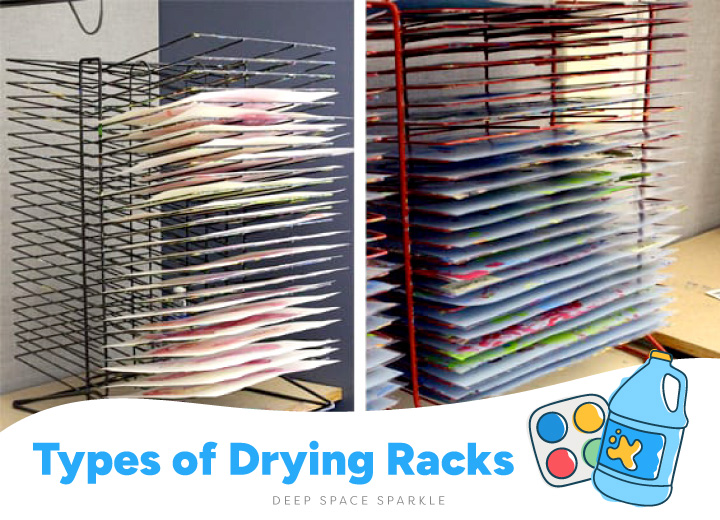
I have never been able to spend a lot of money on drying racks, so I have purchased fairly inexpensive ones.
There are the kinds that have a support rail along the side (red rack) and the kind that has the support rail in the center (black). The black one is certainly better, but if you have the red one, here’s a tip for you: laminate some old 12′ x 18″ papers and use as “sliders”. Place artwork on sliders and slip into place. So much better than trying to wrestle a paint soaked piece of paper.
Portfolios mean easy access…
The best part of having portfolios is when a parent comes into the art room and wants to look at what her child has done.
I can easily go to the filing cabinet, select the right class, find the portfolio (never alphabetized, I’m afraid) and let the artwork spill out in all it’s glorious color.
And if a child leaves during the school year, her art portfolio is ready for her.
Using Portfolios to Manage Free Choice
In a perfect world–or in some cases, a perfect class– kids will have a few minutes of class time left. Some have truly worked hard on their art project and need something to do other than bug their classmates.
It always struck me as funny why some kids would rush through glitter paint and metallic pens to get to a plain white piece of paper and a few chewed up crayons. But they do. Reminds me of when my kids were little and the box the toy came in was far more impressive than the actual toy. Sometimes kids need the opportunity to draw without interference. Simple stuff. Scribbles. Whatever.
But it can also pose problems.
You know when free-choice art time has gone awry when the paper box is being hoarded by table groups and oil pastels and crayon nubs are scattered across the floor. Paper airplanes start to fly and all of a sudden you got major cootie-catcher chaos taking over the classroom. Clean-up becomes extra work now leaving some art teachers (okay, me) to wonder if there is a better solution.
Setting out the classes’ portfolios at the back of the room is a great way to steer children to not only finish their previous work but be able to manage it on their own. If a child finishes an art project, they can look in their portfolio for unfinished work. This only works if the parts needing to be finished are simple ones that don’t require a major outlying of supplies.
But I confess. I’m behind in creating portfolios for my students and so they don’t have them yet.
Do you use portfolios in your art room? Or do you send all your artwork home? I’d love to hear!
Comment below…



Thank you so much for this post- I was trying to come up with a plan this year for storing art from week to week and this has solved my problem.
I love your site!
Kelly
Patty,
Great ideas!! It gives me somewhere to start thinking about how to handle my art room next year. I am blessed with a set of wire storage shelves for every grade level, but I have never done anything more than just use a shelf per class.
I love your blog…read it daily.
I am inspired by so many art teacher blogs to start my own, but my district is currently debating our policy of student work only appearing on our intranet and not out in the big www.
Keep up your great work –
Karen E
Your blog is wonderful, I'm so glad I found it. Thank you so much for sharing your super ideas. It pays to be so organized and I'm sure your students take pride in browsing through their folders. I agree it's great to see progression through the year by holding onto work. Well done!
THANK YOU! THANK YOU! For this post. I was having a hard time figuring out how to save the students work. This helps a lot. THANK YOU AGAIN!!!!
Also, thanks for answering my question about what project to start the school year with. I would love to come see your work in person, if you allow me.
Thanks,
Evelyn
You are all welcome! I'm so glad this post has helped you out. I'll try to do more when the inspiration hits!
Happy Birthday!
I totally agree with you. KEEP EVERYTHING! I do two art shows–one in December and the other one in June. The kids make giant portfolios out of butcher paper and decorate it etc. They take all their work after the December show and then in June bring back the empty portfolio to take the second batch. I love your site by the way!
Hi Patty, thanks for sharing all your experience. Do you every send art work home? Don't the kids ask to take it home? Do you hang alot on the wall?
Hi Teebo,
At the beginning of the year, I show the students a portfolio and explain that all art created in the art room will go into this folder. After that, they never ask, but parents do. Even after explaining in newsletters, etc. some parents still wonder where their kid's artwork is!
At the end of the year, the students proudly take home their portfolios. If I didn't have all the art shows, I wouldn't keep the artwork. But I do, so this method works for me.
As for displaying art, I have four wall sections available. I rotate every month or so. One class per section.
hope thsi helps!
Thanks Patty for your reply. Everything you do on this site is so helpful. Thank you. I just order all your lessons. Thanks keep them coming. Why not publish a book I would purchase that too!
Patt, Do you plan your whole year ahead of time. I am a new art teacher. Any advice you have is so great. Thank you again.
Hi Teebo,
My first year, I tried to plan my lesson in stages, but you know, sometimes it's hard to be too structured. Many times you have to be flexible.
My best advice for you is to do a variety of lessons yourself and get a feel for how you would teach that lesson. You might discover that you would add or delete a step. Also, teach what you enjoy doing yourself.
Good luck and don't worry…art is fun and as long as you are relatively organized and enjoy what you are doing, you will be hugely popular!
Hi Patty, love looking at your site. Great ideas! I am going to tackle the precious peacock with our third graders before Christmas. I know it isn’t a turkey but it gives about the same impression. May even look at it on red paper 🙂
My question is what are the dimensions of your cubby shelves? Obviously they must be 18 inches wide. Just thinking I might put in a work order and see what I can beg to get done. I love the idea of laying the work flat.
Thanks again, Debbie
Hi Debbie,
The cubbies are 18″ wide. If you are getting a custom made cubby case, ask for 19″. Wider helps!
Hi Patty! thanks for always answering my questions. Do your students sign their names on the front or on the back. thanks again.
Great ideas; I am in my first year and feel overwhelmed. Your lessons are terrific! My roster is about to change; back to back classes up to four in a row. NO break between classes; none; not even 5 minutes. No sink either; any ideas????!!!
Buckets or I use a “dirty water” smaller bucket and a “clean water” bucket (labled & color coded!) On each table with clean water only 1/2 way. For painting kids dump their water cups in dirty and refill at their tables which is less movement = more spills. You could use a 5 gal bucket(s) set up as well. I had no sinks before my current job and it was a great solution. Good luck! I did it with preschoolers even. ?
Whoops! = LESS spills!!
Hi Anonymous,
Have you read this post?
http://deepspacesparkle-artroomorganizatio.blogspot.com/2009/10/prepping-multiple-lessons.html
The post linked above might help you manage your class schedule although I think the first thing you need to do is to talk to your teachers. Have the arriving class delay a few minutes.In addition to that, dismiss the existing class early. Between the two shifts, you should be able to arrange for a 5 minute turnaround. No one expects an art teacher to herd one class out while the other class enters. If they do, you still need to change that. You'll provide a better program if there is a minute to breathe.
As for the no sink dilemma: Go to Home Depot and buy a couple of 5 gallon buckets. Fill one with clean water and leave the other empty. Dip empty water containers into the bucket of clean water to fill up; empty dirty water into empty buckets. Kids can do this as well.
For hand cleaning: use baby wipes.
Good luck!
I have no time between classes, one class is lined up at the door waiting for their teacher while the next class is lined up in the hall waiting to come in. There is no changing my schedule since teachers get a set number of planning minutes. My solution is setting a timer to end class early enough to clean up and set up for the next class while the current class is in the room. They can help (its such a privilege to be a helper 🙂 The class can “earn” a 5 minute video at the end of class for good behavior which gives me that chance to get ready If they don’t earn the video , it is a quiet 5 minutes. Rarely need to repeat that! I do what I have to, and it seems to work well. I think teaching how to clean up your space and supplies after making art is really part of it.
Do your parents get upset that you don't send home work earlier in the year?
Do you spend time yourself filing artwork into these portfolios, or do you get a parent helper to do that. I would think filing the artwork would take the most time.
Great tips! I love the idea of color coding student portfolios.
Please check my blog for more tips and projects:
http://www.sgpart.blogspot.com
Hey
I have cubbies also and organize with portfolios…the only way to go! I teach 6 classes a day for 4 days…on Fridays we go in the gym for Art, Music and PE all together. This method works like a charm for me.
My solution for messy hands has been *Art Water*. I have several little spray bottles that I spray the kids hands with…you’d think it was gold water!!! It’s just water! Usually a few sprays and rubbing their hands together gets all the bits of clay or paint off until they can wash up better when their class goes to the restroom. Saves lots of clean up time!!!
Clever! Thanks – now much less back up at my sinks!!
I have large shelves where I store artwork in piles by class, but I don’t save everything – the volume would be too immense. I pick and choose what I want to save for the show. But anyhow, about your shelves – I’m curious – they seem rather small. In my classroom, we do a LOT of large artwork – often 18×24″ or maybe 18″ square. Do you only do 12×18″ artwork or do you have additional storage for bigger stuff? How about anything with a 3-D element? (I don’t necessarily mean the big stuff like papier-mache, but even just relief projects, or anything with an element that protrudes or is a strange shape or size.)
Yes, my shelves were small but they were all I needed. I teach fewer classes than you, so my storage isn’t as much of a problem. I don’t have those shelves anymore. They were at the school where i used to teach. I have large filing cabinets now where I store my student’s portfolio’s/projects. For large scale items like paper and 3-D projects, I usually display them and then the students take them home. You’re right about saving stuff for the art show. If it can’t hang on a wall, I won’t save it in the portfolio!
My first art lesson of the year is to give each student a portfolio to decorate however they want. The only requirement is that on one side they must have their name. Usually, they make giant bubble letters for their names.
Hello I love this site!!! I teach preschool art and I have 19 classes a week. I do a artist of the month and teach about a famous artist like Jackson pollock we splatter paint, Van Gough I add sand to the paint to make it thicker and we make sunflowers and starry nite. My question is should I save all the artist of the month art work for the end or save it for the whole year I am torn. I use folders and a ols cd rack to orginaze my portfolios Good Luck and thanks!!
I keep all my students art in the art room (in portfolios) so that they all of the art is available for end-of-the year art shows. If there is a need or purpose for keeping the art, keep it. If not, let it go home. This might be better considering it’s pre-school and moms want that cute art on the fridge ASAP!
i LOVE the shelf used to store art. I have cucumber and strawberry boxes (the big flats that grocery stores get) for each day. Then each class has a folder. It works great until I start hoarding art for the art show. 😉 Might have to steal that idea for next year!
Hi Patty,
When you hold your annual art show, how much art are you sending home during the school year and do you think it’s worth it to save everything for one night vs. students sharing their art w/ family by taking it home during the year. I can’t figure out how to have a big art show unless I keep most of everything!
What do you think?
Joslyn
I save everything, but remember, I only teach students 15 times during an entire year. I would save only the pieces that are finished. So any worksheets or experiments or even simple warm ups, I would send home if you were limited with space.
The cafeteria lady let me have a large stack of BREAD STACKING SHELVES, the kind the bread company uses to deliver bread to the school. After washing them, I put each teacher’s name on one and the students from that room slide their art into their “drawer”. Even if a student turns in work without a name, I can narrow it down to a grade and teacher. I jazzed up the brown shelves with colorful duct tape and put names and grades on them. Now I don’t have to hurriedly decide whether I will save a certain piece of art for the art show.
Lucky, lucky you! I used to have one of these at my old school. I placed a sheet of bristol board in the slats so it was easier to remove art…just like a cookie sheet.
Good Afternoon Patty,
I am so glad I found you. I taught art and then I retired and now I have returned again to teach art.
We will begin creating and designing portfolios. Our storage space is nill, so I need to be creative.
Will let you know how I solve this challenge!
Bernadette
When a class has completed an art activity, I label it on the front and assess it before selecting 4-6 pieces suitable for display at our local art exhibition. I record whose work I have selected and then send the rest to the classroom for display. The students know that if theirs is missing I have it in their class folder ready for display. That way I have a class set of art ready for display and the classroom teachers can have art for their walls. If it goes home, It doesn’t matter.
ORGANIZING PORTFOLIOS: I organize my student portfolios by class and keep them with their grade level. 1st grade is red, 2nd orange, and so on thru the rainbow! I keep a space holder in between each class. My portfolios are made out of two pieces of 12×18 construction paper. We use our portfolios as placemats when we are doing oil pastel or permanent marker projects.
DRYING RACKS: I keep the drying rack art pieces organized by having students write their name, teacher’s name, and group letter (for split classes) on EVERYTHING they create. (The kindergarteners only have to write their room #). This makes papers easy to sort when they are dry. Thanks for the shelf liner tip. My students have so much trouble getting things onto the shelves of the racks.
END OF YEAR: I keep the art for the art show as well. At the end of the year I make a really big deal out of taking home their portfolios and keeping them forever. It is a sort of last day celebration.
REMEMBERING NAMES: I have students write their name, room #, and teacher’s name at the top of their portfolios so that I can see their names on their desks when I’m walking around. I have a seating chart at my desk to help me call student names when I am seated. Occasionally I look through last year’s yearbook at names and faces before I see a grade level.
SET UP/CLEAN UP JOBS: I have rainbow colored tables, and each table has numbers 1-4. Each quarter a different number is the captain. The captain is the student who passes out and collects supplies & portfolios for their tables.
QUICK CLEAN UP: I use table points and offer incentives. It just seems to motivate my students so well. Grades 3-6 can clean up in 2 minutes flat because the first table cleaned up gets 2 points. It’s amazing. If I know students will resist putting away their project I ask them to put their hands on their heads (“Give me an eye”), then I ask everyone to put the supply they are using away so that it is no longer possible to finish.
INCENTIVES: I use table points, and the winners get either tiny prizes or stickers at one school. My 2nd school has a school wide “eagle bucks” program I get to use. At my 3rd school I just collect a list of the best names and give them to their teachers. Their regular teachers usually have some sort of reward system.
I enjoyed this article! Thanks for letting me participate!
Wow. You are amazing! Great tips. Thanks so much for sharing.
Hi, I am job sharing this year with a teacher that makes portfolios but they sit empty until December/May & then the kids stuff them with all their work on one day & take them home. How do you handle putting the artwork into the portfolio?? I am thinking they should be used as storage for artwork during the semester….can’t remember what I’ve done before!
This is a great question because every year I debate the merits of the portfolio only to realize they are indispensable at the end of the year. I usually let 2-3 projects accumulate before I start sorting into portfolios. Sometimes I forget a few classes and are way behind so by December of January, I’ll recruit the help of some kids at lunchtime!
The best thing to do with the portfolios is to treat them however they serve you best. There isn’t any shoulds–only what works for you!
I have asked the janitors to save me the copy paper boxes and have one for each group/grade. Monday is C day…so I have each grade I see with a C by it…the work goes into the box and then out into their portfolio…This year PTO is giving me an awesome Mom helper to separate all the work as we go and file it better…I didn’t start using the boxes until March of this year…It was quite a mess…I stack the boxes four tall (four groups per grade) and they are easy to access… 🙂 Oh it it looks CUTE too…I did colorful labels for each grade level.
I have a pretty OCD system for storing artwork that I find effective:
-Artwork goes into a box labeled with the class name (we have 1A, 1B, 1C, 1D and so on for all grades). FYI the boxes I use are recycled cardboard from the office- copy paper boxes OR lids that are about 12×18.
-Artwork from the drying rack goes back in the boxes. I have my drying racks labeled by grade level, to help me remember whose it was at the end of the day. It also helps the kids figure out which drying rack to use.
-Boxes are stored on 4 shoe racks I bought on Amazon that are along one wall. I have one section per shoe rack. I spray painted each section’s boxes (A, B, C, D) a different color to help the kids find their work. You could use what you have at school but I liked the shoe racks because the students can reach them even if they are small.
-Whatever they are working on is clipped together by table using a clothespin the same color as their table. That way, passing out papers is super fast- they just grab the clip for their table.
-Old artwork goes in a portfolio, which is always stored on the bottom of the same class box.
Hi Samantha!
I love your ideas for organization. Any chance you could post a picture of your room and these organized spaces? This is my first year as an art teacher and I’m trying to figure out best practices and what will work for me. Thanks so much! Beth
I have the beasties decorate their “porkfolios” with their names & periods (I teach 6-8) then the period. I keep these in laminated table folders for table 1 to 10. For me having a “foldah fetcher” has been a life-saver so I don’t have the heartache of losing precious time I could be getting class started. And it’s been good for my turkey tots who need responsibility and positive interactions. We use them for everything from work-in-progress to hand outs, etc.
Drying rack space has been a bear as they take up lots of counter space! We do have clothes lines set up in the back with a step stool and 2 students assigned to do that. But 210 kids use the studio everyday! Where to put stuff that’s wet or 3d…hmmm, still working on that ?
OH this made me LAUGH! (The truth in it!): “It always struck me as funny why some kids would rush through glitter paint and metallic pens to get to a plain white piece of paper and a few chewed up crayons. But they do.” HAHA! I love the conclusion you draw from it (because I’m usually still just baffled by it): “Sometimes kids need the opportunity to draw without interference. Simple stuff. Scribbles. Whatever.” Love this. Art without restrictions. I am definitely trying portfolios this year. I tried table group folders for “early finisher drawings” last year (my first year) but the kids wouldn’t take ownership for the drawings and coloring sheets that piled up and got smashed down into the pockets for weeks (months) – they never came back to finish them. I also wasn’t sure how to manage art for the art show. Sounds like individual portfolios will be the answer for both. Thanks for ALL your inspiration!
We are planning our first art exhibition for May next year and the portfolio idea is an excellent suggestion. I work with 3 to 4 year olds and we prepare a portfolio folder (called Learning Memories) for each child to showcase their learning through the year. But artwork has always been a problem storing ‘in the mean time’. I think I’ll go with a drop file for each student in a filing cabinet. Will keep things organised for the exhibition and ready to include in Memory Books.
This is my first year teaching art and I love getting all these different ideas for my room!!! I think we may do that as an art project one of our first few weeks so that they can make it their own then go from there!
These are terrific ideas! Thank you! I like to have the students start designing their portfolios the first day of class. I usually give a theme or choice for the design. The students’ names are written in black on the upper left, then their class codes on the upper right. Designing the portfolio (48×36 paper folded in half) becomes a nice time filler. They generally use them for placemats while doing a drawing project. I can tell them to work on their portfolios while I pass out supplies, or if they finish early. One class took the entire school year to finish their folders. There were 4 beautiful clean sides to the folders and they had to think over their designs before starting. Pretty sure nobody rushed their work to get to their folders, but they didn’t complain, either! Only crayons and markers allowed…
I couldn’t manage without portfolios! I have the students tape with masking tape the two shorts side of poster board when folded and taped they can easily slide in 12×18 art work. Ideally they have a theme art project on each side which varies from year to year. Their name goes in upper right hand corner as well as their homeroom number or the day and time I see them. These are stored in my room in a basket for each class. They go home at the end of the year or they have to leave them with me. (This avoids any ending in trash after they leave my class to avoid carrying home) usually a parent will enquirer and can get from me. They also take a photo of each piece and make a digital portfolio and write about their art or favorite piece and why on last page.
Students put daily work into classroom folders (18×24 paper with teacher name on outside). After a few lessons, when it’s brimming, helpers hand it back to students to fine-tune and file into their portfolios (economy poster board folded and stapled on ends). Portfolios are filed onto shelving by grade level and teacher (on edge for easy access later). Re. early finishers, I’ve stopped the waste and paper airplanes by making 10 page sketch books from copier paper and construction paper. Every 1st – 5th gets one beginning of the year, and kindergarten half way through (once they understand things more.) I color code the grade levels which makes it easier to find where a misplaced one goes. I also offer how-to-draw books, legos, blocks, play-dough, and quick draw prompts .
Hey, I used to work in a private school where parents were always around helping out, and could see having a portfolio for those kiddos because the parents might actually stop by, they also had sketchbooks, they had to purchase. But, I NEVER had a parent stop by to see anything, much less comment on anything that went home, when I worked in the huge inner city school. I would not recommend the hassle of portfolios if you have zilch for parent involvement. For early finishers stick with a free draw paper cart in the front of the classroom. Tell them 4 at a time may freely get 1 paper at a time. Use inexpensive newsprint, and marker baskets with a few really cool markers and then the basic colors, highlighters, glitter and metallic markers maybe a sharpie or two. ALSO create drawing folders! I love them so much! Print out about 30 cool designs like popular dance moves, popular vehicles, boats, funky images, famous hip hop artists and sports people, maybe a Mona Lisa and a Starry Night, and make enough copies for 15 pocket folders. Fill each with your copies on the left and your tracing paper on the right, or you can hole punch them and just put them in a three hole pocket folder, so they don’t get stolen, then type a statement you’ll glue inside each folder
*THESE ARE FOR TRACING ONLY! Please trace and replace back into the pocket so your friends can also have a chance to trace them:). They are not coloring sheets. You may only get 1 OR 2 blank sheets for tracing, have fun!
Great tips Jessica! Thank you!
I see almost 700 kids a week and portfolios were a TOTAL game changer for me a couple years ago…every year I tweak what I want done to them and how I like to use them (about to start my 5th year). One big tip I have is to write the Kinders’ names and class on prior to their coming, pass them out the first class and have them write their names themselves directly under where you wrote them. This helps sooo much with identifying whose work is whose prior to their perfecting learning their letters.
Great resource .
Most of my students’ artwork is done on 12×18 paper, so what is the another idea to make the portfolio with? Using 12×18 paper folded in half won’t work for artwork that is this large.
It helps to read all of the comments above first! My problem is solved!
Another question : what is the best, most cost efficient way to mount students’ artwork on black for the art show?
I have boxes from the local Kwik Trip ( usually soda comes in them or other beverages), covered them with contact paper (color coded per class) and put names and teacher name on the box. The students enter the room, get the box which also has a pencil, pencil sharpener, eraser and sketch book in plus any projects they have completed or need to complete. This gives room for small sculptures as well to be stored.
Hi, these are great resources! The teacher tool kit link isn’t working. Is there another way to access it or can you send it directly to me? Thank you!
Hi! This is Bethany from Team Sparkle. Thanks so much for letting us know that there is an issue with the link. We are working on getting that taken care of, so please try again shortly. Thanks!
Thank you so much! This really encourages me to do my first portfolio and art exhibition this year ! I usually send the art home but it’s a shame since a lot of times it ends up all crumbled up on the children’s backpacks.
I’ve only been teaching for 2 years in one school and I want this to be my year to organize better and find more places to teach at.
I’ve always made the kids save their artwork in their portfolios, so they can see their entire body of work together at the end of the year. I have thought it would be a nice thing to try sending everything home instead. Seems way easier.
Use the copy paper boxes or lids to store portfolios. I label each one and have them put their work in the portfolio and the portfolio in the box lid. They stack nicely.
This is great help! What does it mean that you teach in cycles?