



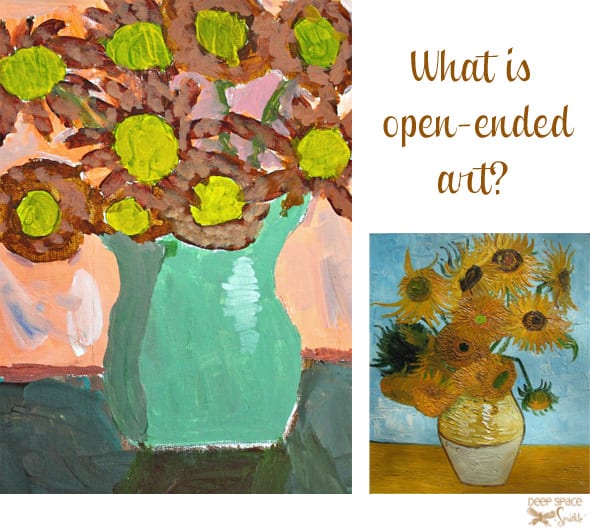
Teaching art is a joy to me. My pace is relaxed, my schedule is perfect, my school is wonderful and my students are lovely. I try very hard to teach children about the world of art and try to cover as many areas of art as I can: artist studies, art genres, techniques and the elements of art. No two lessons are the same and I must confess, that some lessons work out better than others.
Cookie Cutter Art?
Recently, I read an online review of Deep Space Sparkle. It was written by an art education student needing to fulfill a school requirement. The reviewer had many positive things to say about the navigation of the site but then the reviewer said that most of my projects were cookie-cutter projects! Oh, it was like being stabbed in the heart.
In truth, I do use single images to inspire art lessons and yes, many of the student’s works end up looking similar. But the goal is to teach a technique, a strategy for painting, or a study of an artist. Implying that my projects are cookie-cutter cheapens my efforts and my goals of teaching art to children. I mean, doesn’t “cookie-cutter” say so little about one’s efforts and mission?
Okay, so enough about feeling defensive. Let’s get to the purpose of this post. The student pointed out an area of my website that he thought was weak. Critiques are what make you better and opinions are what force you to think, move and grow. So how did I apply what he said?
Well, first I needed to figure out what the opposite of “cookie-cutter” art was and I figured it was open-ended art. I’ve read a bit about open-ended art, but to be honest, I really didn’t know how to translate the concept into an art lesson. So I asked my DSS facebook readers:
How would you describe open-ended art?
Here are a few responses:
- Open ended art is having no expectations about the product – it is all about the process. Showing a student what something should look like is closed-ended because there is a specific product in mind that does not allow for individuality. I never show “examples” because I think it stifles creativity.
- The best open-ended projects are on-going and student-driven. I have my junior high students keep an art journal throughout the semester. They are given guidelines, but each journal is about their own artistic journey and helping them find what inspires them.
- I think open-ended is the way all art should be! – though I am guilty of ‘trying’ to get kids to complete their art project in a certain amount of time… and have items ‘finished’ to take home – but LOVE it when parents understand that a child’s own direction and initiative is more important than if it is finished or ‘looks as good’ as the child’s beside them.
- Something that gives kids the opportunity to do it their way. I run a creative reuse nonprofit, and kids get to take 7 items from our art truck, and make whatever they want (except a weapon!). It is amazing how many ways their mind can go.
- I would say that it is a lesson where the child can choose their medium and decide how to convey their idea. I do an abstract art project that is “open ended” and it is very exciting to see what the students come up with. They really enjoy experimenting with the different art materials.
Responding to Criticism
Aren’t these responses great? I love the open-ended art process (as described above) and I spent most of my life in my own little open-ended world. But what about teaching art in a school environment where standards are imposed and classroom management valued? Is allowing children to choose mediums, supplies, subject, etc., teaching them art? Should every art project be open-ended? How does an art teacher do this?
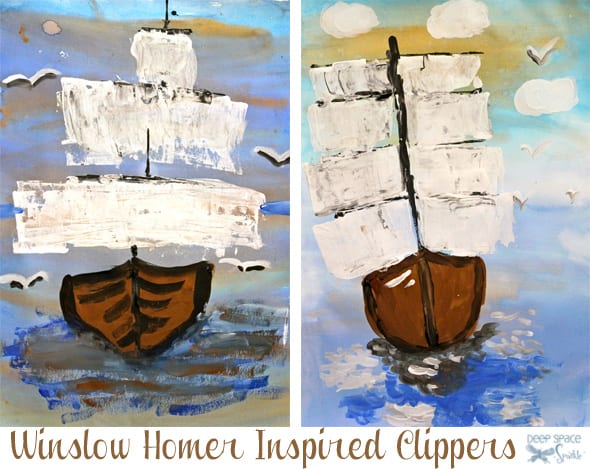
After reading the review, I went in to teach for the day. In fifth grade, we were working on painting a clipper ship. As I sat the group of fifth grade students around me, and began to demonstrate the techniques, the words “cookie-cutter” kept creeping into my head. I tried to push them away, but they were stubborn! You see, I used an image I found through an artist’s website of a beautiful clipper ship sailing towards the viewer. I looked at the painting and saw ample opportunities to teach wet-on-wet watercolor, an artist study on Winslow Homer, and a cool technique to make the sails. But as the children were completing their projects, I knew that my single image prevented the children from creating their own clipper ship perspective. This haunted me for a while until I realized that not all my projects are like this and that the students learned so much. Is this bad? I certainly hope not, because I thought that each child made such an exquisite piece.
Art teachers are creative individuals and need to teach (at least mostly) what is authentic to them. You must come into your art room excited beyond measure about your projects or else the children won’t be. My dear daughter sat through her entire seventh grade year doing open-ended art projects where she could choose colored pencils or markers and draw whatever her little heart desired. The teacher had no expectations, no curriculum, no instruction and worst of all, no passion. My daughter chose not to do art this year as she felt it was a waste of time. So while the teacher might have assumed that she was doing right by her students by not giving any instruction, I couldn’t help but think of all the things I would do with 50 minutes a day with each class.
But in defense of open-ended art, I would like to point out that I do value open-ended art (on occasion!) Watch this.
So what’s your take on open-ended art. How often do you use it and in what context? Can you teach a lesson on Van Gogh using this concept? I’m quite curious and excited about your responses…it’s so fun learning new things!
Download our free management, set-up, drawing & painting guide, to help you teach art from your home!

As an art educator I find the web very inspirational. My schedule is hectic-draining all of me sometimes. I’m thankful for some ideas. I don’t always like all that I see when I’m surfing for ideas- but sometimes when I see something that is worth trying I change the lesson a bit and make it my own to fit the needs of my supplies, schedule, curriculum, abilities of my students, and my philosophy regarding art education. I have found your site useful- keep up the good work!!!
I find it difficult to do completely open-ended projects with my 600+ students. I have large classes and a rapidly growing group of special needs students. In a perfect world an open-ended lesson would be fantastic but then reality slips in and the parameters of time, budget, class size, curriculum requirements, etc. work as obstacles. So I do what I can and when I can slip in some open-ended opportunities I do.
I love your website! Everyone is going to have an opinion… isn’t math “cookie cutter?” Everyone uses number, symbols and formulas to come up with other numbers and such (confusing to me) things!
I think students want to learn techniques; and, hey, I want to learn techniques! I believe teaching techniques helps students gain confidence in using a certain medium. I have students tell me that they drew something I taught on their own at home; they are proud that they remember the step by step lesson.
I do teach lessons both ways, “cookie cutter” and open ended. After teaching a few step by step lessons I sometimes give a choice assignment where students choose what to create based on a theme or idea. I did this a lot with junior high but don’t have as much time to do this with elementary but I try to squeeze in choice assignments. I do usually encourage students to choose which way their paper should go, their colors or their details so each one is a bit unique.
I think they really enjoy the freedom to make their own choices in a work of art but at the same time they are surprised or impressed at what they create when they have followed along with me.
No matter which way art is taught I think the most important thing is to teach kids to see and develop confidence in art whether they are following along or exploring on their own; I often narrate the thinking process of an artist, I sometimes ask them to verbalize it too. I really love the ideas of Marvin Bartell from Goshen College. I wish I had heard of him before I got my teaching degree; I would have attended his program in a heartbeat! Here’s a link: http://people.goshen.edu/~marvinpb/MB_Home.htm
Also… I’d really like to try my hand at teaching your Winslow Homer, Clippers lesson…. I love the examples you have here. Looks like some palette knife painting and I have been looking forward to teaching palette knife painting!
This is one of my lessons in my Beyond the Basics ecourse (next session February)
I have been teaching middle and high school art for 12 years and always loved open-ended art projects. I loved how one persons drawing would inspire someone else in sculpture. My students created artworks beyond their own imagination. I also found they could teach each other techniques rather than always running to me. This year however I moved to K3-8th grade and I think I lost my mind! i see all 600+ students in a four day rotation, have some in the classroom and some art-on-a-cart. The creativity is limited. I utilize your website to show them a beautiful variety of age appropriate examples. Thank you for creating such a resourceful website.
I have been teaching elementary the last 2 years and this is my first year with middle school. How did you introduce the open ended projects to get them inspired?
I don’t consider your projects “cookie cutter” AT ALL. I see you teaching techniques, styles, and strategies – things your students need to be able to create their own art. You’re providing foundations and sparking their creativity, not limiting it. Keep doing exactly what you’re doing and thank you for such an inspirational blog.
There is a balance between too much instruction and too much freedom. Teaching techniques and giving some successful formulas for creating and learning in short periods of time is absolutely valid! You are empowering them and giving them confidence. They are so often proud and feel successful after these type of projects. I try to intersperse some free drawing time, and some days I do try to give more open ended assignments and the students enjoy these as well. A more open ended assignment might be putting a box of construction paper scraps on each table, a bunch of pre-cut squares of different sizes and colors, glue sticks and tape. then talk about robots, maybe show a few references of robots. and tell them to make a square machine. The first and second grade love this project, but they also love the projects with a lot of instruction as well. Deep Space Sparkle projects are wonderful! Keep them coming!
I agree completely with Cindy deRosier.
I recommend DSS to every art teacher I meet!
You know, I think that there is learning and benefits both for the so-called “cookie cutter” projects and also for more open-ended projects. I homeschool, so I really appreciate the step-by-step instructions that lead to similar designs, because I have NO IDEA what I’m doing. What I love, though, is that once they’ve tried a new technique and created something fabulous, they have the confidence to use the same techniques and skills on something new. They are constantly pulling out a new sheet of paper and combining ideas, trying new things, and ending up with great results. I think that the step-by-step “cookie cutter” projects give CONFIDENCE and show the students what techniques will yield what results, so that they feel comfortable with different mediums and ways of doing things when they sit down to do something more open-ended. 🙂
I so agree with Erin!
We, as elementary teachers, are laying the ground for more open eneded art expereinces to come in the future as their art world unfolds around them. Patty it is evident that your students add thier own style and creativity to their work. It is just as in everything in the world…we need a little guidance and directions. One example that comes to mind is the remote to my television that still gives me fits. I had to look at the instructions to figure out how to use the crazy thing. Yes, I might have figured it out to an extent by pressing buttons, but would I know all the remote secrets? I think not.
Keep on shaping our students and providing them opportunities to achieve greatness with their creativity! Kudos to you, your teaching and your energy to share with the rest of us!
Julie
Personally, I find value in both open ended and instructional art projects. I think, especially for young children, they greatly benefit from being taught specific techniques. How would my kids ever know what happens when you use oil pastels and then watercolors if I didn’t show/teach them? How would they learn about lines, perspective, color and form? We expect kids to be creative, but without any background knowledge or exposure to beautiful things, they don’t have the tools to be creative WITH. You, and other wonderful, passionate art teachers like yourself, are giving children the tools they need to be creative. Yes, kids will often immitate what you show them, but I don’t see anything wrong with that. The experience they have painting a clipper ship, or their self portrait, or an impressionist style landscape will teach them something about how to do that type of art, and who knows where that will take them later. I do value open ended art, just giving kids some supplies and allowing them to create whatever they want – but I value instructive art very much and I think what you do in your classroom, and sharing your art lessons with the world, is a lovely blessing to everyone you touch.
Hi Patty,
I remember thinking the same thing about “cookie cutter” projects when I started teaching at the elementary level. My students barely ever use a stencil and I encourage students to draw from real-life and not trace whenever possible. Of course, you will have some students who have a very hard time and need more guidance and may benefit from tracing a certain shape. It also depends on the project you are teaching. I show different examples so my students realize there is more than one way to create their project. I find that if I only show one example, they all want their work to look like mine. We discuss what they can add to make their work stand out and I encourage them to be unique. When you are grading, it is hard to let them go and create what they want. And when they follow your criteria, sometimes they do tend to look similar. I also find when I let my art club create an open ended art project, they have a difficult time starting or end up wasting materials. On the other end, I have also seen some very creative use of my materials. It is fun to see what they come up with on the open ended projects. I have a student who adds a wolf into every project, whether it has to do with animals or not. It is fun to see her creativity as she adds a wolf on her shirt for her self-portrait lesson, a wolf howling at the moon next to her tree for a silhouette landscape project or wolf tracks in her Fall leaf painting. As long as they are learning the process or technique you have introduced, it shouldn’t matter.
Hi Patty,
I’m one of your many silent visitors. Thank you for this post. You handled the “constructive” criticism gracefully. The fact that used it to double check your teaching methods speaks volumes of your dedication to the field of education & the quality of person you are.
Your “cookie cutter” projects have served as perfect opportunities for my children to learn concrete fundamentals. Later, after learning the ” rules” they were better equipped to freely express themselves through whatever new medium or style they had learned.
I see your lessons and ideas as recipes. How can one possibly know how to bake a cake when left with nothing more than vague instructions and a few ingredients? Following recipes to a “T” , the first time, allow the baker to later fine tune and personalize the recipe and make it their own and later create original works of culinary art.
Thank you for all the time you put into making these ideas available to us all.
Thanks for joining in! I appreciate your kind words. Love the idea that lessons are recipes!
I teach art at a private classical program school The school is small so I teach all the kids in the school, grades K-12. Here is what I see as cookie-cutter art; if there is no specific instruction, we get the same row of daisy-like flowers with the same petals marching in a row, grass-like spikes on the bottom, a band of “sky” at the top, a symbol for a “sun” and maybe a rainbow. That same work of art will be produced over and again by the entire class whether they like art or not. This is the symbol drawing they have somehow acquired to show me their “art”. My job is to get them to draw something else! And to find out that the sun does not have to be represented (in every single drawing) by a yellow circle with spiky lines. If I give them free drawing time, (no matter the age group) and free choice of supplies, I pretty much get that same drawing over and again. That is cookie-cutter art. For all those budding art teachers out there who think it is wrong to stifle a child’s creative talent by instructing real observation skills and real techniques; they need to see what a real child is like. Creative, yes, but not a great artist automatically. Great artists have to study and work very hard.
So, Patty, I do not think your lessons produce cookie-cutter art. I use them myself to conquer the actual Cookie-cutter type of kid art.
I agree! This is exactly what I find when I don’t offer suggestions or visual opportunities…the same flower, the same sun.
Hi Patty, I have my own little studio, my student classes are as large as 10 students. I have researched infinity websites and read several books with different ideas on how to teach art and I always end doing what I feel works for my students the best, before I found your website two month ago, I was so concerned If I was cutting my students creativity by teaching from a lesson like the one you prepare or I myself put together “Open-Ended Art Projects” and I have to say there is not other way to do it and having the results we have: Happy students who are taking art classes for two years now and still want to do art over any other activity. Teaching young children art and keep them engaged is not easy! I had try many different approach and kids know and they don’t feel good when they end with a mess of artwork due to lack of direction. Now, how can you help a school group of students with out having the structure of an Open-Ended art project and get the successful results we have? The only way is a one on one private art lesson! What I teach is technique, opportunities to create beautiful and uplifting art work, individuality: my students always have the chance to change things around if they feel comfortable and just few of them usually come up with their own version, My students learn to enjoy the peace that comes from creating and the process that it takes. If anyone out there figures out how to keep kids excited about art classes for two year in a row as I have being doing to this day I would like to hear it, but there is not other way to teach art in a group bases unless we use Open-Ended lessons and yes their art work would look some how the same, but until children are old enough to create their own projects they will continue building their artistic skills by developing technique, learning how to use materials, how to take care of them and the process of creating. You are doing a Wonderful JOB!!! Thank you for helping me find peace in this amazing opportunity we have to teach other to love what we love!!!
Do mean to say closed ended ? Your post keeps referring to open ended which implies very little direction , but then u refer to guided instruction which is more closed ended like Patty’ s lessons (and my own) . Am I not understanding or did u mean to say closed vs open?
I also find that children are more creative when they learn techniques. I use open ended sketchbook days between guided lessons and exposure to new artists. Now they still ask “How do I … ” and I can reply more openly by referring to something we’ve seen or done. It gives us a vocabulary and tools. They think about it and often start in enthusiastically with great expressions of their own.
I know i am late to the conversation, but i just found your amazing site. I very much agree. I am trained as an elementary educator, self taught artist and now a Classical homeschooling mom. Children NEED direction and technique. Some children are more creative than others naturally, but all children can be taught art. Sometimes the less creative students actually have more at talent. I took art classes as a child from a friend’s mom, who was an art teacher. I didn’t think I was a good artist, because her lessons were very open ended and I am not naturally creative. As an adult I had a budding interest in art and began teaching myself to paint my reading, studying, and watching artists. I learned to create by learning from masters. I found artists that inspired me and learned from them, watched tutorials teaching me to paint like them. Young children are taught by copying. They also gain confidence by looking at a picture and learning how the artist created a masterpiece. Otherwise they get the impression that art is too hard and they will never be like that master. Art is a very abstract thing to a child and most do not naturally see things like shape and color, perspective until they are taught. Your lessons I belive take intimidation out of art for a child. Just like a good piano teacher would never take a first year student to the keys and ask them to compose a pretty song. They might think their “piece” is amazing, they may be told that by the teacher, but there will come a day that they will hear what they are playing and realize it is not good. To create students who love their art, be it visual art, music, dance, etc you have to give them the tools so that they eventually begin to put them together to compose their own art. I think the critique given to you by the student, was probably given with little thought to pedagogy and little real life teaching experience
I agree
I do not think your projects are “cookie cutter” at all. I have used numerous lessons from your blog, your purchased lesson plans, and plans from your first Teaching Art 101. I love that they teach technique, but they do not all turn out the same. “Cookie cutter art” does not teach technique beyond glueing and cutting, and there is no creativity for the student in this method. You use techniques and offer guidelines, but the student can still be creative. Even when templates are used for some of your lessons, there is creativity. I hope that you will keep offering your lessons because they are such a great help and blessing to so many people who teach art. You are an inspiration to so many. I liked your example of your daughter because it show what only open-ended would do. Everyone needs technique to help in their creativity. If a math student sat in a classroom with only a book, paper, and pencil, he or she would not learn math without instruction. It is no different in an art classroom. The student who critiqued your lesson plans might want to teach them to young children to see how great they are. Then he might see they are learning technique, and they can be creative! We want our children to be successful and love art!
When I think of cookie cutter, I think of the project being very prescribed with no room for individual interpretation. Your students do seem to add their own flair to each project. I think art education in techniques and styles is so important. Even the great masters copied art to establish a foundation for their later work. I would feel, as your daughter might, that having no direction at all would be overwhelming in itself. I love the work you do with your students.
I think one should use both variety of lessons,sometimes one can let kids work freely with what is given to them, but smetimes they need definite guidelines which greatly challenges them, and this is the way to teach them different techniques especially drawing
Hi Patty,
I have used your site many times with much success in my studio…I am not in a school setting but have a great studio where kids can come and create. K-6 can be a time when kids are deciding how they feel about art,sometimes a so called cookie cutter style gives them the success they need to explore more and to me that’s the key….,making a child feel successful with their own creation will open up so many other things to them…I also do not like the term cookie cutter…it means they are all the same and they are not…two could not be alike if you tried…I do an afterschool program with sometimes 100 children..we all do one project with 100 different results…Please keep up your great inspiration! I love it!
I struggle with this daily. I teach K-6 Visual art in two buildings to almost 1000 students on a weekly basis. I see each student only one time per week. Needless to say, I am CRUNCHED for time! That being said, my background is in High School Visual Art- specifically ceramics, printmaking, and drawing. At the high school level, much if not ALL of what I taught was student-led, self-differentiated, and open-ended. Students had the basic technique knowledge AND had prior history of divergent thinking to develop ideas on their own and trust their instincts to use their artistic voice in whatever they completed given whatever parameters I set up. I found, though, that there must always be parameters- material limitations, size limitations, thematic content etc. In a dream world, I could offer up everything from poured bronze to stone lithography to digital photography for a project and just say “GO”. In reality, with tight budgets, facility limitations etc, there have to be parameters. Once I made the move to teach “littles”, I engaged them or attempted to engage them in the same open-ended, self-driven style of work that I did with my “big kids”. What I discovered was that my little ones needed guidance to be “open-ended”. They needed parameters and encouragement to step outside the box, options for differentiation, and specific DIRECTIVE tool usage modeling. Once they had these “tools” in their belt, the idea of independent, self-directed, and open-ended projects was much more appropriate and understandable. I have balked against guided line drawings because I want to encourage observational skills BUT I also see such success with some of my students who NEED a clear model to ease them into their own divergence. This will probably always be a source of discord with art educators and those who feel that creating with “art materials” is art. We (in my art teacher circle) call it a “Hand Turkey” project. What is encouraging/showing/requiring a student to trace their hand and turn it into a turkey teaching the child about creativity, self-advocacy, artistic intent, AND the intangibles in art- mood, feelings, style etc? Truly, I find that I defend teaching creativity, divergent thinking, problem solving, tolerance and empathy in the arts more than I do material usage…. AND those are the areas that I believe are most important. I try to balance my approach with littles, doing much more guided drawing or modeling with the youngest of my students and then tapering that off appropriately as they age. By the time they are in 6th grade, I want that self-differentiating artistic voice of theirs to be familiar and used often. Wordy sentences, heavy topic… would love to hear more!
This is such a good response and from such a great perspective. I can well imagine how high school art differs from elementary school art with Littles (which is the best word ever!). Thanks for adding to the conversation!
Here is a really good example of a very directed line drawing with wonderfully different results; https://www.deepspacesparkle.com/2009/06/30/line-drawing-art-lessons-turtles. I use this lesson of Patty’s every year with kinders or first graders. Sometimes we do a cat or an owl but the turtle is the best beginning one. This year I chuckled as I got turtles with spikes on their shells, in fact all sorts of non-turtle adornments and accessories. So original in results, yet we started with direction. And to the student’s pride, they all do look like turtles.
It would appear that the student who reviewed your site has never taught art before, at least to grades K – 6. If the reviewer has taught she would know that students like structure. Many of them have never worked with the materials being used and need guidance and instruction! Open-ended projects are more appropriate for grades 7 – 12 as these students have the critical thinking ability to take an idea and run with it. But even then, they need instruction! The role of the teacher is to give students the materials and techniques to be able to create a successful piece of art, not just experiment with a process.
I was ready to write a response, but you said it perfectly.! I have been teaching for 27 years. Younger students need and want structure and instruction to provide them with the skills and confidence to be creative. That said, I do leave, in most of my lessons, room for individual creativity. And it is rare when students artwork looks alike. So, I find his talk about cookie cutter art very offensive. Especially from someone with little to no experience. I really admire how gracefully Patty handled this!
YES! That’s exactly what I was thinking! It’s all about balance. Not every kid is going to have a good sense of where to start. Sometimes they need a template to get things started. Sometimes, they don’t. I like to provide my kids with both options.
Ditto!
As someone who believes that Art is an Academic subject, I personally find that some of the projects presented are “cookie cutter” but I still love the ideas. That being said, as a trained Art Educator not a teacher with a concentration in Art, I recognize that all Art programs at the tertiary level are not created the same. An experienced or master teacher would be able to take an idea or technique shared on this website or any other, and individualize as necessary. Child development is very important in realizing that children are not the same especially physically and socially.
During my teaching career I have seen children and materials change. Today’s children do not have great fine motor skills- but they can really use their thumbs! Art Educators are expected to teach so many basic skills in a very short amount of time. Everyone, parents, teachers, specialists teachers, expect the other to teach the skills. With the younger children it must be a cooperative effort. Easels and paint are no longer in the lower primary classrooms. Glue has been replaced by glue sticks. Crayons by colored pencils. In the using of “safer” “easier to clean up” materials exploration and “messy” is lost.
Because of standards and testing, many children are afraid to fail and want to copy what the teacher does. For me this is plagiarism. There are many things in Art that are prescriptive; the proportions of the face, how to mix colors, drawing, building with clay etc. Learning technique is very important because without it children are lost. There must be a balance between teaching Art History, technique, and the doing. I can tell a child what to do but they don’t experience success until they try it a couple of times. You can’t do it just by hearing it.
I always think of the media exploration stage that all artist must go through. I let children know that the first time it is so that they can see how the materials work; use them for how they are made instead of fighting them. Children already know who is “good” at doing a specific Art task, so each persons art inevitably is different.
So all that is to say the teaching of technique is to make the child a better artist, how they use the technique shows their thinking process and creativity.
There are many judgements made in these replies, including my own. We are not in this classroom so it’s a matter of perspective.I think we must examine and reflect upon our teaching philosophies and ask our selves if we are fulfilling it or just going with the “standards”. Additionally, as viewers of this website we only see what is shared.
I TOTALLY agree with your diagnosis of the testing and standards slump. My students (as much as I have instilled in them the need to be creative, different, and thoughtful) have lost the ability to think outside of the box. If their work doesn’t look like mine, it’s “wrong”. What has happened here? I am blaming testing, the “right and the wrong”…as much as I try and push and coax, I have kids in tears daily.
This year I’ve been focusing on my primary students using tons of variety in media so that they’ll (hopefully) not hit that slump….UGH!
good luck, times are changin’…
I’m not a teacher, but I often use your lessons with my four year old daughter as I’m trying to help develop her hand-eye co-ordination and give her a foundation in basic art techniques. In my personal experience, we often did similar art studies to what you teach (though in later years we were choosing our own visual objective within the parameters of the exercise) all the way through to some of the courses in my university years. Art lessons like this provide a foundation. It is the reason the masters of yesteryear copied their masters work again and again. They were learning the foundations they needed in order to be able to produce creative work with the outcome that they intended.
When my daughter has free art time she often draws the same thing over and over again. The subject changes over time, but I will no doubt receive 20 or 30 similar images over the course of a fortnight. She is expressing her own thoughts/situation/environment and that is wonderful, if a bit repetitive. The directed art that we do expands her skills. She learns what happens if she blends colours, she puts salt on wet watercolour, she tries drawing from a picture or from a object (2d vs 3d image), what effect layering different colours of paper can produce, etc. She is learning basic skills that build, and with those foundation skills she’ll eventually be able to branch out on her own using those skills. Since we started doing these art techniques, she’s expanded the base of mediums that she uses (during her free art time) and will now happily combine mediums which before was a foreign concept. We also do a lot of ‘what happens if?” based art to encourage experimentation.
All in all, many skills are developed the same way. Cooking, sewing, knitting, art, whatever. You build up an arsenal of techniques, you experiment, and you make ‘mistakes’, and from there you can use those techniques/skills/observations to express your creativity. There is nothing wrong with these types of lessons. Children (especially young children) often need a goal to focus on whilst they learn about the subject matter/materials. Many of them are also visual learners and need that visual influence. How many people stare at a blank piece of paper and don’t start anything because they don’t know where to start? I don’t think of it as ‘closed’ if they are trying to create (or re-create) something that *they’ve* not attempted before.
Your daughter is very lucky! What a wonderful opportunity you are giving her. And I agree. My purpose is to expand children’s artistic awareness while remembering that they are children. Thanks for your input.
What I think is that cookie cutter is a wonderful path to follow. Would you go hiking without a map? Would you attempt to build a house without plans?
I learned to play Bridge a few years ago and I often got so frustrated with HOW to think without, you know, really grasping the whole of the game. A woman once said something I’ve never forgotten: “None of us were born walking!”
Accepting criticism is never without its stretching and pulling. And sometimes we only “hear” a term and envision its worst-possible meaning. I think, were I to critique your site, I’d have a hard time finding anything “wrong” with it. Truly. [and no I am NOT blowing smoke up your skirt!!] There is such variety and your approach is very broad while each little bit of focus also inspires.
I am a retired teacher and an artist who is teaching a visual arts activity as part of a program for elementary-age kids who come on a sort of field trip. I get the kids for 45 minutes. That’s it and that’s all. This school year everything is different BEcause someone different is overseeing the program. I am just there on a per diem thing.
BUT… thanks to you and the time I have spent perusing DSS, I had put together a couple of comprehensive lesson plans which included BEfore they come, while they are there, and many expansion possibilities for the teachers to take back and use in the classroom.
Well, I learned shortly BEfore we started that A. the coordinator was no longer there and B. the people taking it over weren’t at all interested in my extending the activities. [and, the teachers from last year were the ones encouraging me to “expand” this…]
Anyway, it’s working out okay. I’ve set my sights a little differently, I am still having fun, and the kids AND the teachers have, so far, been thrilled. I usually DO something collage-related, but when things were shifting I was able to see an entirely new path to try.
HOW?! Glad you asked!! BEcause I have seen the range and breadth on this site and I know that all things CAN BE adapted. What if, I wonder, you were as blase about how to DO an activity saying: well, whatever you want to DO, go ahead, and you gave no instruction or point to move toward?! I’m afraid that without cookie cutters all we’d have would BE cookie much, half-baked, and impossible to eat.
So, take the criticism as a perspective. One Person’s Perspective. Like everything, there is no Right and no Wrong. I’ve read many of the comments above and I hear other teachers, educators, home schooling parents and I can imagine many, oh so many more voices who would see this and, NOT to protect you from imagined slings and arrows, only to enlighten you with yet another and another perspective, tell you how great your “cookie cutter” ideas are for giving them each and all a map to the forest.
Open-ended or cookie-cutter, is one really “better” or the other “worse?” Our differences are what make Life and Learning [and, frankly, teaching] so very amazing and delicious.
I give you kudos, Patty, for putting this out there. Somewhere along the way I heard that opinions are like… and everyone has one. So BE it. I don’t imagine this student was a lone educator out there trying to make interesting, compelling, and truly educational projects in the bits and smidgens of time left in our schools. [okay, I won’t go there, but, it’s just, well, I’m just saying…]
Keep cookie-cutting and exploring and sharing, Patty!! You are a treasure. And this site, hands down, there isn’t anything like it.
Brava!!
I adore your website. When I was teaching first grade, I used it constantly because it was so practical and real. I grew up in New York City where museum art was all around me. I want my students to feel inspired by real world art all around. I feel your teaching provides this kind of medium. Perhaps cookie cutter was not really what that student meant. Sometimes you do want to model how to make something look the way the artist intended. My kids LOVE when I can show them how to draw an owl that looks like an owl. There are so many kinds of art, we must let children see everything so they can feel it for themselves. You are a great servant in the world of art. Thank you for sharing it with us.
When I think of “cookie cutter” art the image of 30 art pieces, EXACTLY the same, posted on a bulletin board comes to mind. I don’t think that fits what you do at all. As a teacher I see my role as there to present new materials, concepts, guidelines and inspiration. That said, I am happy when kids veer from what might be considered a “norm” to take their artwork down their own path, so to speak. Back to that bulletin board image — I like it when I am able to post student work that is varied and shows individual creativity using whatever concept or media we might be trying out. However, as someone pointed out to me, when a little artist takes home his/her artwork which was on the school wall, it is unique within his or her own home where it hangs alone, whether or not it was made to look like his/her neighbor’s work!!
I struggle with that issue in my own art lessons. I think as long as we are mindful and build as much opportunity as possible for a child’s individual expression to show, we are on the right path. The fact is that children need guidance and modeling. In fact, as a child, I had a very open-ended art teacher who refused to give us much direction (he always said, “Be creative!”) and I found it incredibly frustrating. In fact, it turned me off to art for years. I didn’t have a natural talent for art, and he failed to teach us the skills and techniques needed to move me along. I think your projects hit a good balance between providing children with opportunities for creative expression and enough structure so that they can learn and be successful. Most importantly, you are developing a love for art-making in your students. When they grow older and are ready to really “fly” with their artistic expression, you will have built a strong foundation of knowledge, confidence, and technique- exactly what they need. 🙂
This is a very interesting discussion. There are many ways to make art with children–no one true way with art, is there! But you might be interested to know that there is a large group of teachers in public and private schools, suburban and inner city, who teach for individual artistic behaviors to be supported in the art class. I taught this way for over 35 years with as many as 960 elementary students per week and classes in the mid-30’s. The teacher creates a solid structure in classrooms set up as studios and students are supported to gradually use media of their choice to make art that connects with their individual passions and interests. If you are interested in learning more, there is an article in this month’s ARTS & ACTIVITIES magazine
(note from Patty: I removed this link as it wasn’t working)
We have a website at http://teachingforartisticbehavior.org
a very active Yahoo forum and a Facebook page
https://www.facebook.com/pages/Teaching-for-Artistic-Behavior-TAB/144118082280049?fref=ts
You can see what one studio classroom looks like here:
http://www.slideshare.net/katherinedouglas/teaching-for-artistic-behavior-tab
Teachers College Press has published this:
http://bit.ly/17hnjv
This sort of teaching is not for everyone, but it supports differentiated learning for the huge diversity of our students and varied school settings. I would be happy for you to take a look and write to me if you are interested in more information.
Regards,
Kathy Douglas
twoducks@aol.com
Twitter @twoducks
Thanks Kathy,
I’ll have a look at your website to see what TAB is all about. It sounds intriguing.
Hi Patty–sorry about the bad link…I am a bit unsure how the digital editions of magazines work…! Thank you for your openness to this discussion which is rare in our field. I believe that art educators, of anyone, should be eclectic–ie., taking the best from many practices to form a pedagogy the best suits ones own students and setting. So if there are bits and pieces of what we do that are helpful, that is a good thing! Thanks again for helping all of us reflect on what we do and why we do it.
Skill building, then Develop advanced techniques.
They have to TRY IT once, at least, to experience it.
They need the basic skills in order to have the independence to create on their own.
This is how the Fine Arts and various crafts are learned around the world.
(and as many art professors and art professionals have expressed it)
It is no different than Mathematics or Reading. You need to know your times tables and the alphabet in order to do math problems, to read a book or write an open ended creative writing paper.
This is different than open experimentation with art and craft supplies that are used to do whatever students want to do in a non directed environment. That is not what we teach in an art classroom using state and national standards.
I’ll be honest, I would never teach a lesson like this one: https://www.deepspacesparkle.com/2012/10/04/starlight-pumpkin-art-lesson/
When I was in school for art ed, my professors always emphasized the importance of having students make authentic art, which means keeping lessons as student-centered as possible. Does it mean I give kids paint and a brush and leave them alone? No, because the results are what some previous posters touched upon – nothing too exciting, a lot of rote symbols, etc. But I also don’t want to have 30 paintings of something only *I* thought up, either. I’ll give them a theme to work with instead (but if a kid has a different idea of what they want to do, I am happy to let them). I also don’t like guided drawing. I would rather spend that time working on observational drawing and helping kids really learn to “see” and practice drawing realistically.
I pretty much only do process-based art with my K and 1st students – I think student-centered exploration of different materials in the lower grades is important. And for so many kids, the process of creating the art *needs* to happen before they start making “finished” art that looks good by adult standards. I’ve also found that bringing back, and using a new material on a piece of art that they worked on in a previous class really helps them slow down and “finish” their art to their satisfaction.
In the interest of time and the number of students I have, I am limited in some respects. But I try to only show them how *I* would make something, and leave the rest up to them, even though I find myself making sure they don’t just copy my example. I recently realized that only showing a first grade class how to cut a free form shape out of paper was what they needed to make some really interesting and truly unique collages (the previous week I had gotten 20+ collaged rabbits because that’s what my example was!).
Sometimes I do teach very structured lessons – for example, I have students draw line drawings of leaves (though I just show them how I do it, and what the process is), and then they use crayons and watercolors to learn about wax-resist and painting techniques. But then I continue to do painting lessons that expand their creative choices – they think of the idea they want to express with the prompt I give them (if they need a prompt).
I want my students to become creative problem solvers who know how to use art materials and understand art concepts, and part of that (for me) is letting them have a say in what direction their art takes. There is currently a dearth of creativity in the American child, with standardized testing taking such precedence in public education. I want to get my students to *really* think about what it means to be creative, and for me, process-based, student-centered, authentic art is the way to make that happen.
This post sums up my thoughts on creativity and the American student:
http://www.creativitypost.com/education/as_childrens_freedom_has_declined_so_has_their_creativity
A couple of years ago my district required me to start giving grades to all of my students 1-5th. I have wrestled with authentic ways to address this, keep track of this, be fair about this … and they also said no blanket grades. So I have approached it as it the students were working artists hired for a specific piece. I required objectives and looked for creativity within those objectives. I know that clients would not appreciate a warm color scheme when they asked for a cool one. so…. I know this is simple but it helped me justify the giving of grades to those who met the criteria. There may be a time to “break” the rules and draw criticism like many famous artists did. Those points may be worth the statement you make.
The “giving of the grades” (recorded in a computer program) is what caused me to explain to children that I was being graded on how they completed their projects based upon the objective. I use to tell them that the first piece of Art work was for my grades and what they did after was for them. This worked well and children would produce an incredible amount of work. Sometimes I don’t think we give children enough credit for being perceptive.
I am also an art teacher and I love your site. To me, the outcome is just as important as the process. It is vitally important (in my mind) to use “cookie cutter” projects in order to teach kids technique. It’s a difference in philosophy, and I wouldn’t let that comment bother you in the least. So what if most of the kids’ work is similar? You’re inspiring them and giving them a “jumping off point” for other artistic explorations. I still see enough variety in your student’s work. I would chalk his comment up to the possibility that he was tasked with finding something to criticize for his paper. You should be proud of the work you do. I think you’re great! 🙂
There is a time and place for both methods. Think about it, if you told a group of kids to make a clipper ship without giving them any instruction or showing them examples, they would have no idea how to do it and they would be frustrated. I think this is where preliminary sketches are important -you demonstrate, they follow along and have time to formulate their own ideas about it, then begin the final product, where you will see more individuality. Open- ended art is wonderful once the kids have a base of knowledge to pull from, and we are responsible for teaching them techniques, providing them with images, examples, and inspiration, and then they can take it from there, of course within limitations. I think structure, limits, and boundaries are crucial for getting quality art and the most creativity out of the kids. You need something to fight against.
First of all I would like to thank you for myself and on behalf of all my students for the hours and hours of creativity that you have enabled us. To see all children as creative is to put them in the cookie cutter category. There are children who are talented in math, or writing, or music, or sports or science or whatever and we as art teachers have to teach them all. Those who are truly creative in art will use your projects as a jumping board, an opportunity to express their own ideas. For those who aren’t, your lessons are a comforting framework which in most cases will result in a project they are proud of and will be happy to see on the bulletin board or in a frame at home. For the younger students I very often gave them free art and they loved it. But for the older ones it could be a disaster leading to behavior problems and even ruining the lesson for those who love art and thrive in an art class. Even the greatest of artists learned from copying from other great artists. Art is a skill to be learned like dancing, sports, music etc. and to say otherwise and to expect otherwise demeans art. Again thank you. Sincerely, Margie Ben Dov Jerusalem, Israel
I love this discussion! I’m not an art teacher but I had a fantastic art teacher in the elementary school. She gave us time to work on long term projects that focused on observation and drawing from still-life. She showed us techniques like framing using your eyes and we were free to explore. What I enjoyed most about the class was the fact that I discovered 3-dimensional perspective on my own by attempting to draw a table. While it wasn’t perfect, I loved the fact that I was allowed to experiment and try various lines to get the desired effect.
When I subtitute taught a fifth grade class, I remember showing the students various ways to create perspective. I showed several paintings to demonstrate and even drew the techniques on the board with no one final picture as a model. Then the students were set free to explore using different media. I was amazed by the originality and creative ways that these students showed depth and perspective. While I showed them basic technique, I couldn’t have taught them to put it together in ways that were meaningful to them. Each picture was drastically different from one another.
Now, I’m a homeschool mom and allow our daughter plenty of time to explore and discover without the pressure to create a beautiful product. But because she’s been begging for art lessons so she was draw realistically like Leonardo da Vinci, I signed her up for classes. She comes back with the same images as all the other students. A lot of it seems like copying which has its own value. But I wish there was more room for creativity and expression. Since the art classes have not hindered her creativity at home, I believe it served its purpose of learning a specifc technique. But all in all, I believe a great deal of practice in seeing and applying the technique to various settings and medium is necessary for mastery.
I love the question you raised because it discusses how we teach, not just what we teach, which matters!
This site is amazing, and the support from those who love it is even better! Of course if teachers and parents who believe strictly in open ended projects have passed through this site, they have passed BY and have most likely not come back.
I am not a trained art teacher but I have been a teacher of every subject and every age including the special ed population and the gifted. When my school eliminated my gifted position I chose to open my own education center and life is great!
Right now my art lessons are in the form of Artist Trading Cards so I adapt many of these Sparkle lessons to a tiny format. We begin with a card of one technique, theme or artist as inspiration and the participants are encouraged to make what ever they want after that – but that can be stifling for some. And if Sarah (above) can refer to the “Littles”, then I will add that my Friday night ATC workshops include the Littles, the Middles and the Olds – my oldest “students” are in their 70’s (and the youngest are 5). So I agree wholeheartedly that kids need to experience a technique and have an opportunity to examine examples – but so do older adults who were ONLY given cookie cutter art “lessons” in school. The projects that my mother recalls from her elementary years (when the classroom teacher was also the art/music/PE teacher) were literally pasting projects with the pieces pre-cut by the teacher. There was no creative experimentation allowed. And as a pre-service elementary teacher in the 1960s she was “taught” to teach art by using construction paper, scissors and glue – crafts, really.
So these older adults are as afraid of art as they are of technology. They need as much instruction as the kinders. 🙂 I find great inspiration here for all ages and I love the idea (above) that they are “recipes’ for successful experiences. Keep up the great work!
Open ended art doesn’t have to mean a free-for-all, either. Research TAB Choice art education – great resources in the TAB community! A choice based art room does not mean no expectations if it is done well.
I don’t run an entirely choice classroom by any means, but have found that having ‘use what you’ve learned’ days – where students can use the techniques and concepts we have been studying to create their own artwork, is extremely valuable. It is a good way to see if students can actually apply what you have been teaching to their own artwork in a successful way, and allow your students to use what they know in innovative, and experimental ways – like an artist 🙂
I have been an avid voyeur of the goings on at Deep Space Sparkle over the years and as an art teacher of twenty years ( on and off to teach in class, have babies etc) I felt the need to write for the very first time. Why? Probably because after a four year break with my littlest one, I have plunged back into art education with all the enthusiasm, passion and doubt that plagues us all. Doubt about art being seen as just a fun filler by other staff, the inevitable finger painting lady comments from parents, authentic assessment, cookie cutter activities and the conundrum about stifling ones creativity.
Patty, I truly believe that art is about creating meaningful arts experiences. It is about giving students the opportunities to explore new materials, build on skills, learn new techniques and be in a safe environment where every success is celebrated and when things go wrong, as they often do, there is guidance and support to try again, explore new avenues, evaluate other options. I have found that students love and crave skills and techniques that allow them to become more affluent as an artist. I believe my job is to equip each of my students with a whole array of skills and tech iCal advice so that they can be true artists. This is not just skills for the classroom, but for when they step out of my door, where they are truly master artists of their world. I would not expect many students to just come to know how to arrive at a mathematical answer for a problem without first being given instruction on what a number looks like, how to form that number, how that number looks in the concrete manner, the abstract manner etc etc. Why is it that we expect our art students to just draw a portrait of oneself and expect it to look different from the way it was done in grade two if know new skills are taught. It is amazing the light bulb moments when you say to students that your mouth is approximately in line with your pupils that the exponential improvement in the width of the mouth will be done. How is this wrong? Give students the ingredients and they will learn to be more successful. By all means at the end of all your teaching of skills and techniques have an open ended task (with guidelines) that can cater for individual interpretation, but “front load ” your students with knowledge, skills and the same love and passion you have for the subject, as it is, as all the arts is, enriching to the mind, body and soul.
Thank you Patty for all that you do. Thank you to all those who inspire young artists and the old ones like me to look at the world through a rainbow of colour.
Wow….tons of comments on this one! Honestly, I think as art teachers we all teach differently and there really is no precise way to teach. Whatever works best for us, works best for us.
I personally don’t think your projects are 100% cookie cutter because students are free to choose colors, patterns, etc. in many of your projects. I think some might view it as “cookie cutter” because, for instance, with the Homer Clippers, all students are creating clipper ships. I don’t see anything wrong with this and works for students. On the other hand, you could model and demonstrate this creating a clipper ship but then let the students have the freedom to create any kind of water vessel of their choosing, whether it is a sailboat, catamaran, pirate ship, clipper ship etc. But I think either way is fine. As teachers we know our students and know what way works best for them. I do know that it makes a lot more work for teachers that give a lot of freedom to the design of the art (not cookie cutter) especially when grading and creating rubrics for the projects.
By the way, I love your Princess and the Pea lesson! What a great lesson!
I have read the other comments and have very little to add, but I really wanted to say that in my experience with teaching, 20+ years, each child has different needs and skills and we cannot just expect them to create something. Each artist learns from copying and changing and working. I feel your lessons give a very strong base for each student to find success and learn the basic skill and within that framework each child has found a way to express his or her own self. My children went preschools (two different cities) where the works of art were all the exact same, perfect in fact. I wished they could have been given more freedom, but even in that framework they each found ways to create (at home using the skills they picked up at preschool). I believe as teachers we need to guide, and that means some framework. I feel your lesson give freedom and guidance for each of the children to feel confident and continue expressing themselves through art. I have seen with my eyes how your instructions have been taken out of my classroom and grown into the child’s own expression. I have only praise for your lessons and am very thankful you share them with us.
I just spent some time looking over the TAB links that some of you included in your posts. They were extremely helpful. I like this approach to art…maybe not on a regular basis…but certainly as a model.
The only problem I see with integrating the TAB approach is space and time. I see each of my classes only 15 times a year (average class 45 minutes). I also share my art room with other teachers and wouldn’t be able to set up stations.
For all you TAB experts, what would be the best way to implement a TAB art lesson–not TAB art program?
Here are a few ideas: at the beginning of several sessions of painting, give students tempera with magenta, turquoise, yellow, white, palettes, smallish brushes, a sponge, small good-quality paper. Demo putting colors in to palettes with brushes and rinsing/wiping brush on sponge between colors to keep their paint tray colors fresh and thick. Then let them go mixing colors and naming the results. Invite them to write colors on the chalkboard when they make an amazing discovery, ie., Y+B+W=spring leaf or B+Y+R=monster slime, etc etc. Assign students to paint a sample of colors on their paper to save for future reference. We find that students who discover color recipes rather than copying color wheels gain an intuitive grasp of color and are far more adventurous and original in their future paintings.
before starting on a 3D construction unit assign the attachment challenge: with lots of small found objects offer string, yarn, brads, threaded needles, etc. Assign students to create a certain number of different attachments using a certain number of different materials (depending on age and experience of students) These solutions could be tacked to a bulletin board for future reference. Expect lots of clever solutions.
Before a paper sculpture experience: challenge students–how many different ways can you change 2D paper to 3D? How many ways can you make paper stand up? how can you make paper support a heavy weight? etc etc.
what do you think?
I love this color exploration lesson. Color theory seems easy but truthfully, it’s a hard concept for students to grasp. This lesson puts the discovery in their hands. I have two 6th grade classes tomorrow and it’s the end of our rotation. I plan to do this. I’ll blog about what their experiences were like but you have to promise to come back and give me feedback! Thanks for the suggestions!
a quote:
“Color Mixing
When things are going smoothly in the painting center, it is time to set out tempera paints. This paint is ideal for color mixing and invites a demonstration with paint palettes. Children are expected to mix all their own colors, blending paints to please themselves. Upon seeing a newly blended color, a student observes out loud, “Wow, look at that army green!” The teacher comments “Look how that red stands out next to the green color you mixed.” Another child asks “What colors did you mix to get that skin color?” Sharing amazing discoveries shows color theory in action without having to demonstrate it. Students like Sarah share their techniques and color discoveries with classmates:
First, I was trying to make it look like a sky painting but then I added some other colors. I took paint and put it over it. Then I took sgraffito sticks and I scraped some of the paint off of it. The paintbrushes had some paint on them and I dabbed them on the paper. I took all kinds of colors and mixed them all up together on the palette. My most favorite color was the sky color.
Sarah, grade three
Color wheels are useful tools for inquisitive artists, but for many painters including children, color is intuitive. Students who paint often become aware of fine nuances in color and develop skills which serve them well later in the year. By experimenting and playing with paint, young artists learn how saturated colors can evolve into tints, tones and shades.”
Chapter 8 Painting: ENGAGING LEARNERS THROUGH ARTMAKING Teachers College Press 2009
http://bit.ly/17hnjv
One more quick link: regarding products of open ended art teaching–keeping in mind that the teaching is quite thorough and focused–the outcomes are what are open ended. It is possible to demonstrate in such a way that the teacher does not know what will appear from the students. dozens of photos here from various choice studio classrooms:
https://www.facebook.com/pages/Teaching-for-Artistic-Behavior-TAB/144118082280049?sk=photos_stream
thank you again for this discussion. I wish there were more thoughtful conversations such as this one in our field. Comments on all sides of this issue have been wonderful.
This is all about media exploration. Artist must be given the opportunity to learn how and what the materials can do so that they can be used for a purpose.
What helps me integrate centers and some TAB philosophy into the art room is CARTS – all those old overhead carts that were in storage now house painting supplies or oil pastel supplies, or collage supplies – so that if it is a project day, and we’re painting – I wheel out the painting cart – OR if it is a ‘center’ or ‘open studio’ day – I can wheel out a few carts and place them where I want that particular studio to be.
Trying to manage multiple studios in one classroom with 24+ students will force you to streamline your organization and classroom procedures in ways that will help your project work, too 🙂
Oh, goodness- I am not an art teacher, but when a student is learning something- anything- it is necessary to have a model to go by. Honestly- you could even call learning to write a cookie cutter endeavor.
If you told your students to draw a clipper ship and gave no guidance or ideas or inspiration, probably 90% of them would give up the job as hopeless. They would be frustrated into art paralysis. Is that the goal here? NO!
What your critic may not have enough experience to realize is that these kids are going to take what you teach them and run with it. They are going to go home and doodle clipper ships in the margins of their notebooks. They are going to take out paints and mess around making different versions of what you showed them. They are going to run into different Winslow Homer art pieces in the world and be thrilled to recognize the artist.
Don’t let one flippant comment from SOMEONE YOU DON”T EVEN KNOW AND WHO DOESN”T EVEN KNOW YOU ruin your good work. Because you are doing good, great, wonderful important work.
Your reviewer was just doing a homework assignment.
Agree agree agree – many good responses here – I love your site and use many ideas with my preschoolers – thanks for a great site!
sorry, this makes no sense. You can give students many pictures of clipper ships and let them create their impression or idea. There is never a reason to have students paint step by step your ideas. What were you teaching? Homer? He probably had many pictures to look at too. What else could you be teaching that they could not paint their own ship and still get. Giving students choices does not mean they are not given instruction!
I do not consider your ideas “cookie cutter” art–what a great sourse your website is for us! I have been teaching art K-8 for 32 yrs in various schools. You are a wealth of information. What I do see now in certain art educator magazines and college teaching is a tendency to “homogenize” art projects and techniques’intregration with other subjects”which loses the joy and value of art itself. It is almost like the art projects or art teacher in not justified unless we are under someone else’s topic. As an art teacher I do not choose to “copy” your ideas but use them into my own program when bereft of ideas or applications. You show that your students have independent approaches to the projects. Bravo!
we use several sites to come up with ideas for an art class we have at a local library, we present an image of a project, give them supplies, and let them go at it, each child does their own thing, esp since the age range is from 4-12. We use examples as a starting point. 🙂
Teaching 400 students is all about modeling the lesson. When you have 39 Kinders in one class, and 37 1st graders in another class you have to be able to show examples and let their little wings spread! Open ended art lessons are not, necessarily, a bad thing. I challenge anyone who doesn’t have these large classes to try and let them be as creative as we really would like them to be. Organized chaos is how I describe these big classes! I enjoy, and have used many of, these art lessons on Deep Space Sparkle! Keep on open ending all you want!!!
I just had to add to the party! So many great responses! I teach art at the college level and in K-5. It is clear that the reviewer is a student themselves and still learning about the distinctions they describe. Your projects are not cookie cutter. Providing guidance and inspiration is called teaching art. ART. Our job is to expand children’s imaginations as well as their skill set! This notion that there is some sort of “pure” expression inside people that teaching is going to spoil is ridiculous! Kids ARE geniuses but they need to be challenged! They deserve to be educated about the history they are participating in as soon as they pick up an art material to work with. They deserve to see images and be exposed to concepts that nourished the artists that came before them. Doing that–providing context, inspiration, and the opportunity to explore and experiment–takes their creativity MORE seriously than treating every random mark as “special.”
Many of my college students have been indoctrinated in to this notion that anything that they do with art materials is unique art. But you know what, during that first critique, when they put their “own” open-ended expressions on the wall, they are surprised to see how similar, reductive, and “cookie-cutter” their free images are! Rather than let that be a demoralizing moment, I present it as a challenge for us all! We spend the semester learning how to find inspiration; struggling with the limitations and opportunities that particular media and technique provide us; and reclaiming our power as creators, thinkers, experimenters, and explorers!
So. I get worked up about this. (: I just wanted to say as vital and essential as emergent curriculum and open-ended art making is, please let’s all work to understand what that means! It does not mean not teaching! It does not mean not providing visual inspiration through images and examples! (Do we want TV, advertising, and Angry Birds to be their main source of visual information?) It does not mean not teaching technique. (It’s OK to teach the alphabet isn’t? Same letters for everyone, legible enough that the letters can communicate feelings and ideas?) Yhanks for inviting this discussion!
Love your example with college students! How powerful! There is a problem with defining the term “open ended!” We should create a collective online definition!
so a new 1st grade teacher from another state said to me a few weeks ago “I am so glad you do projects with the kids!” I was confused and said, “oh, you didn’t have Art at your former school?”
She said they had art but all they ever did was have paper and time to make a picture of whatever they wanted. She said “You teach them something!”
nuff said
Oh boy! What a sore subject this topic can be. I hope you are taking it all with a grain of salt and will continue to listen and learn from all you hear, see and do. We never do stop growing as teachers. Trust me I’ve been at this way too long to know. There are times when I beat myself up and feel like I’m doing it all wrong but I get a good nights sleep and go at it again the next day. I love what I do. There are times I feel those who have never done what I do have no idea what a huge task it is and how much there is to manage. I’m not perfect but I do try hard to do my best and make my students feel happy and satisfied when they leave my room. I think I’m doing OK and I think you are too Patty!
Patty,
Keep up your amazing work! You have helped me become a better art teacher and I just love your style of art lessons. I think you are passionate about what you do…..and kids feel that. Isn’t THAT what it’s all about?
Thanks for sharing with us!
I have been teaching art in NY state for 34 years. Your site has freshened and inspired my teaching. Exploring art materials and creating is a wonderful thing but……why not teach techniques and how to use different materials. A new technique or artist creates inspiration Science, math. social studies, and english and music do not start with no prior knowledge-we need to share what artists have learned like the proportions of the face, how to mix colors rules of perspective. I think your method is a vast improvement over the 60’s and 70’s when people were left on there own to rediscover the wheel. Kudos to you Patty!
I find myself teaching the computer generation how to hold scissors, the parts and types of paint brushes and what they are used for and how to usan Elmers glue bottle! Many k students haven’t seen a pair of scissors in their life! Gone are the days when mothers stayed home and gave their children learning experiences of every ilk. Computers and video games don’t make a mess in homes where both parents are on a tread mill! Art in the schools is more important than ever!
Hi Patty, I’d just like to say that you are an inspiration to me too! I have almost 400 K-5 art students in a small school in Northern NY. I love your projects and tips and your site is the first one I go to when I need an art teacher pick-me-up! God bless the art ed. student, if that person actually finds (and lands) a job teaching art to real live students they will understand what it’s like to have to assess children’s art work and that to keep EVERYTHING (supplies, displays, grades, storage, clean up, the list goes on) going, guidelines are a good thing for everyone involved! I get people’s words stuck in my head all the time too, it stinks, but try to let it go! You are amazing! Thank you for sharing your ideas with the rest of us! Keep up the great work!!!!!!
Wishing you peace & love & a clear mind!
Tara Abbott
I’ve taught all levels of public school now plus some college teaching. I used to think that the best kind of teaching was very open-ended. I have changed my mind however and I now think that a truly good art lesson challenges kids to be creative within limits. Life is like that too- you are always having to work within limits. Plus, many kids are just stymied if you offer a completely open-ended project. kids need a starting point and you offer great starting points. No one says they have to stop with the project where you stop- many of my kids add other things.
I just stumbled upon your discussion about open-ended art. I have the great honour of teaching art at a small alternative school in Nova Scotia where we emphasize creativity and individuality. We have a good balance of instruction and open-ended exploration, so I thought I would share the way I teach art.
Being inspired by an image is something many artists do, so keep that starting point. Introducing new skills is important too, unless children have limitless time to explore – pretty rare these days. For your clipper lesson, the only adjustment I would make is that when the time comes to switch from listening to making, have many images of different kinds of sailing boats available – clippers, schooners, lasers, etc. and encourage the children to connect with one of the types of boats in some meaningful way in order to pick the one they are going to make – a memory, a dream, a feeling, a story, etc. Then they paint using the instructions they’ve learned from you while using their powers of observation combined with imagination. They will be making a piece that has some depth of meaning for them, something they will connect with (helping them put more effort into it) and each piece will be unique.
We talk a lot in our art class about copying and about how it doesn’t allow your creativity to grow. We also talk a lot about being inspired by something or someone else’s image, but changing it to “put yourself” in it, thereby making it your own. Many student teachers come to train with us, bringing “art” lesson plans that are actually crafts: follow steps 1-5 and you will come out with a product that looks lovely. Making art is about making choices, conveying messages, making people think, and creating something no one has seen before. Sure it takes extra time to find good images to work from (I especially like line drawings and images from old books) but it is so worth it. Give it a try and I will be shocked if you don’t hear the most amazing stories and ideas coming from your students. Let me know how it goes if you try it.
Look at your one point perspective lesson: https://www.deepspacesparkle.com/2012/03/05/one-point-perspective-art-lesson/ . Cookie cutter art?? You’ve taught a technique and the student have created their version. You do a fantastic job. Your students and school are lucky to have you.
Oh, Patty! I hope you truly feel hugged and reaffirmed with the overwhelmingly positive response you’ve received! I teach art at the elementary level, specifically K-2, where there simply has to be an inspiration point, an introduction to different materials, a demonstration of skills and techniques and then the opportunity to create or respond, which is exactly what you provide in your lessons. Students at this level need time and the opportunity to confidently explore and experiment with techniques . Your lessons provide just exactly that, making up the bulk of the curriculum and giving students the opportunity to build and develop skills and confidence in manipulating a wide range of media. Not every teacher that is required to teach art is artistic, but you make your lessons accessible to ALL teachers, regardless of their skill level, so that students in any classroom can have excellent opportunities to grow and develop artistic skills and creativity. The students who want to take it further or add their own twist, do anyway, which is fabulous! The students who need structure and support have it. Everyone achieves and creates something to be proud of… and what is wrong with that? Aren’t we spurred on to do more through positivity and achievement? Your samples of student art work don’t look like cookie cutter art to me (which I think is where every single piece looks identical)… your students demonstrate that they have freely played with placement, detail, colour, whimsy, texture etc and show self-expression through adding their own flair to their work. Your lessons are the bread and butter staple diet of elementary art experiences. Students also continue to play with these ideas, skills and techniques in their own time, as well as (what we call) ‘free-create’ time at the end of the lesson or during a lesson set aside at the end of a unit or end of term. They still have plenty of opportunities to revisit, take what they have learnt and take it further. We sometimes do completely open-ended investigation such as 2D paper into 3D art, BUT that’s not what we do all the time. I believe our goal as teachers is to inspire and encourage creativity and equip ALL students, regardless of their ability, with the skills to work creatively with a wide variety of media, through providing enjoyable experiences and usually all within a limited time frame! That is exactly what you do, Patty, except you take it one step further and inspire the teachers who in turn inspire their students! Thank you, thank you, thank you!
I think “cookie cutter” is unfairly negative. In my experience, children are often relieved by the boundaries of a project. Giving them the guidelines and dictating a method helps them to stay focused on the techniques. I am always surprised by the amount of variation in the pieces even still, and I see that the young artist’s uniqueness still comes out. And more importantly, they see that all the pieces come out uniquely beautiful or “cool.” I’ve also found that giving guidelines keeps younger ones from one-upmanship in adding more and more “cool stuff” on their pieces. A little is fine, but giving total freedom usually ends with a lot of very similarly composed pieces, in my experience, and usually in ways that are not very constructive.
We all begin our art projects with some form of ‘cookie cutter instruction’. It is what happens afterward that tells what has been learned. Do the students apply the skill or technique they have acquired in a new way? As an art teacher, I feel that is the greater challenge- to allow time for me students to experience what happens next!
Your blog is a wonderful resource, keep the posts coming!
We all begin our art projects with some form of ‘cookie cutter instruction’. It is what happens afterward that tells what has been learned. Do the students apply the skill or technique they have acquired in a new way? As an art teacher, I feel that is the greater challenge- to allow time for my students to experience what happens next!
Your blog is a wonderful resource, keep the posts coming!
After reading this blog post I had to introduce you to our app and company –
My name is Eyal and I’m the founder of iMagine Machine™ – we are the developers behind the award winning art app – Faces iMake-Right Brain Creativity.
Faces iMake is all about creativity and imagination.
IT was developed in conjunction with the artist and educator – Hanoch Piven (pivenworld.com)
It would be amazing to see all of you teachers exploring and creating with and without your students.
Here is what Suzanne Pre K- 5th Grade Art Teacher from Brunswick Acres said –
http://baart.weebly.com/1/post/2012/09/faces-imake-app-introduces-faceworld-and-i-am-one-of-the-1st-featured-artists-looking-forward-to-exploring-faceworld-with-students.html
If you would like a code please email me – press at imaginemachine dot com
Thank you
Eyal
First of all, I want to say that I’m truly inspired by your colorful and imaginative website. I get many ideas and inspirations here to which I build upon with my own ideas. So, I do really love your art!! I have my degree in art education from a liberal arts school in Ohio and teach grades k-8th.. I’m sorry to say that when I stumbled on your site, I too, thought the lessons were great but that everything looked alike (sorry). This was a big “no no” at the college I attended. We were to give no preconceived notions of what a “zebra” should look like, etc.. It was drilled into our heads that this was “coloring book art” which was a big no no. Even the store bought holiday cut outs, cookies cutters, etc. were off preconceived notions of how things should look. In essence, if you do a guided drawing and have everyone draw a bird the way you do you are telling them that this is what a bird should look like. Not all birds have round heads, flat backs, etc.. Instead, when I teach, I motivate them with pictures of birds, look at the shapes of their bodies, heads, etc. and then give them parameters such as, ” filling the entire space of the paper, draw a bird using shapes that you saw, including it’s body, tail, head, etc..” I’ll demonstrate a specific art technique or process that they will learn that goes along with the project. and then let them draw a bird based on what they see/imagine not my notion of a bird. Kids definitely need guidance, themes, techniques and such but they should generate their own ideas of what things look like.. For example, I just finished teaching first graders a lesson on machines. They were to invent one to help them do anything they wanted. I showed them visuals of real machines, Dr. Suess ones, etc. We looked at the shapes, gears, pipes, smokes stacks of machines,etc… Then I gave them the objectives they had to meet with their machines: must be large, start with a basic shape, build upon that, must have an on/off switch, draw with sharpie then paint with watercolor (which I demo as I go), etc.. Some machines were triangles, some organic, geometric, etc. but they all looked totally different. I think this is what the reviewer may have been stating with his comments. I wish you well and I think you’re highly creative and imaginative. Thanks for the inspiration you give us all.
I am like you, constantly striving to create more meaningful art experiences while maintaining classroom management and expectations. What you described as your daughter’s teacher definition of open ended art to me just seems like the teacher checked out. Open ended means to me exactly what it says, the product is open to interpretation. The beginning of the project needs to be well researched by the students and/or teacher, have guidelines, and a driving question or problem for students to address (sometimes we solve it and sometimes our question leads to a deeper question which is even better!)
I think many times as art teachers we teach skills throughout a unit. But we shouldn’t stop there! Those skills are necessary just as new vocabulary words are important to the writer, but the words don’t create the essay! It is how the students use the skills learned in these lessons to create open ended art! It certainly should never be looked at as a “free for all!” What do you think?
I definitely hover between the two open ended and prescriptive constantly. But always try to find new ways to create an open ended final project in a unit.
I can say in my limited experience…first year teaching 2nd-12th grades art class to students who must take my class whether they enjoy art making or not (mainly speaking of the upper grades here), I LOVE teaching the techniques to all grade levels in a more structured lesson. What I am finding in my lower grades is after I demo the project, or do a directed drawing, the children ALWAYS ask, “Can I add _____ to my picture?” My answer is, “Oh, yes! This is your picture.” What I love love about teaching techniques is for these lower grades it is giving them a toolbox FULL of wonderful useful tools. YES children should explore the process and materials, but what I am finding is that within a certain project such as our oil pastel/ watercolor owls they ARE exploring within boundaries. Watching them paint today, was a joy as they played with their paint in the confines of the owl. I like that. Art does not have to be boundary-less. in my opinion.
The subject matter may be the same, but the student’s final artwork always has its own vibe.
I teach 950 fourth grade students in Ohio. I appreciate and admire you for reflecting on your approach to teaching. I think many elementary art lessons are limited by being inspired by only one artwork, and it results in the students copying it or making variations of that one artwork. Or “we’re painting roosters today,” (what about enlarging it to be any kind of bird?)
You might open your art projects up a bit by showing your students more artwork — the web is full of paintings of the sea, and some will want to paint a clipper ship, but others might go for a rowboat, a pirate ship or a mermaid. You can still do a few quick demos of painting water, skies, clouds, and even ships, but it’s very easy for young students to feel that your example is the best, the only way to make good art. And quite frankly, that is what limits them to making similar looking artworks. This approach turns out adorable paintings of clipper ships, but doesn’t really engage personal artistic expression.
I teach over 900 fourth grade students in Ohio and my worst nightmare would be to teach a lesson on still life drawing and end up with 900 van gogh-ish sunflowers in the same vase.
The key is to convince my students that they CAN do it their way. I quote Picasso: “It took me four years to draw like Raphael, but a lifetime to draw like a child,” and I ask what is it about children’s artwork that he liked so much — what do kids have that adults don’t? “Imagination!” “So if you draw like a child, Picasso envies you and tried to draw– like you!” I have posters of still lifes by Matisse, Cezanne, Braque, Van Gogh and of course Picasso’s childlike drawing of a hand holding flowers next to his realistic white pitcher.
I have color xeroxes of creative examples from previous years, so they never see an example made by me. Students who are less confident might copy one aspect of avstudent example or Picasso, but they always add their own ideas to it. I feel this approach is a balance between too cookie-cutter vs too open-ended. We are all drawing vases of flowers, but doing it our own way, using our imaginations.
Wow, you can always tell a hot topic when you see lots of comments. I think we all strive for balance. I’d like to think most of my art is open ended but that doesn’t mean I throw open the doors to my art room and say, “There’s the supplies kiddos, have at it.” I do some guided drawings and know that I’m giving students the recipes to experiment and also provide open ended assignments with parameters so they have direction to use the elements and ingredients they have learned. Patty, I think you have a wonderful ability to tie literature with art and am so thankful I stumbled onto your site years ago.
Thanks for having the courage to post this experience.
J
I am in the middle of my fifth year teaching elementary art. My mind-set now is very different now after four and a half years teaching K-5 art than it was when I was a pre-service teacher. I have just over 500 students whom I see every three to four days, depending on grade level. I am very blessed to be the art teacher at one school, and in my own art classroom. Other veteran teachers know the challenges we all face: a short amount of time to squeeze in everything we love and want to share, teaching art on a cart or in a non-traditional space, limited budget and supplies…I could go on, but you all know what I mean.
I think in the ivory tower university setting it is very easy to be critical, but when you are in your own classroom, alone with 25 or 30 students, expectantly looking to you to be their guide, it’s a very different situation. This young man, whose intentions are good, I’m sure, just doesn’t know what he doesn’t know!!
As elementary art teachers we take little 5 year-olds with limited fine motor skills and teach them how to be in an art studio, how to handle glue, scissors, a paintbrush. We build on skills every year. We teach a vast array of media: painting, collage, printmaking, clay, drawing. I’ve seen a child in a Title I school who didn’t have crayons at home. I’ve seen children from a very affluent family whose parents could, but won’t provide art supplies at home because they don’t want them to mess up their house! What worlds we open to children when we set paint trays on their tables! With my fourth and fifth graders who now have the foundation skills, I can offer more open-ended art lessons and a wider range of choices, such as color schemes, material choice, a broad topic from which to start. Hopefully as they leave me to go on to middle school, they will carry with them a love for art and their middle and high school teachers will continue to help them build on what I have begun. Wow! What a legacy we can share!
I think we all need to remember as we are working with these little ones, that it’s not really about the product, but about the process. Yes, maybe when we display examples of the same project together, it may look ‘cookie-cutter’, but I hope when they take their art home it will be lovingly displayed and saved and be a reminder of happy hours in their elementary art studio. Remember, they will only see their own portfolio once they take it home! When their parents look back at what they made in kindergarten alongside what they made in fifth grade, I hope they proudly see the progress their precious one has made.
Patty, your site is an inspiration to so many of us, and I applaud your self-introspection and being willing to share it with all of us, something you have done in previous posts. I think it’s something we all should do as we serve our students, to continually improve our teaching. We walk a fine balance between guiding/setting parameters and allowing for individual expression. What is most important, is that our art rooms are a safe haven for children to create and explore.
Those of us who follow your blog know that you don’t rely solely on single paintings for inspiration for your lessons. We know you draw from a wide variety of sources: artists, literature, etc. I have grown in developing art lessons, thanks to you. As a beginning art teacher, I relied on lesson plans from other teachers and from the internet. Your series of posts describing how you develop lesson plans have been instructive to me and I now have a notebook of inspirations from which I can develop my own lessons! Your enthusiasm for art and teaching and your open-hearted sharing of your students’ work and your lesson ideas are a joy to so many art teachers.
I think, contrary to the critique given by a student, that most projects that I have seen, are “open-ended.” Instructing by example gives tools to the students. It gives them a goal. In my experience, kids who are given complete freedom of choice spend more than half their time fretting over the most minor details, and they can’t move onto what the project intends. I love your ideas. I have enjoyed the on-line class. I just used the directed line drawing of the sailboat with my 1st graders. They loved it. I always remind each grade level that there are a certain number of steps that they have to do, and then they make the choices to make the artwork their own.
Patty,
Aren’t college students so cute? While I respect your ability and willingness to take this young man’s criticism with respect and thoughtful reflection, I feel a deep sense of obligation to come to your defense. Your website is NOT cookie cutter art and your young critic clearly has no idea of what cookie cutter art truly is. I have done many of your projects with my students. I have connected them to artists, famous works, principles and elements of design, literature, and techniques. I have been able to expand upon them, or simplify them as needed. They are beautiful, enriching and thought-provoking. Elementary students need modeling and direction just as much as they need the freedom to make creative choices. Your projects allow for both. In the elementary setting, every project cannot be a do-whatever-you-feel free-for-all! A lesson which will no doubt come the hard way when this student finally gets his own classroom. Live and learn, right? YOU ROCK PATTY! keep it up!
Open ended is great, but you do need the techniques. I teach literacy to 9,10 and 11 year olds using an technique developed by one of UK’s best literacy advisers. The premise is a child can’t until they have learnt how. So: Imitate, innovate, invent. Show them how to do it, (imitate) they can use the artists techniques to recreate the drawing you want; (innovate) let them use those techniques to create art ‘hung’ on the original style; (invent) using the technique, where can they take it. Might mean each project takes a little longer but may work. Certainly works for writing, may need a bit of jigging to fit with art, perhaps reduce the innovate portion. I’ll leave that to you, I struggle to draw a curtain…lol. Good luck
I think you make a lot of sense.
First…thank you for opening up that can of worms! I have read almost every reply and have learned so much as a result. I also find it important to give structure with my K-2nds but was intriqued with the open ended discussion…I will be researching that more in the future. I couldn’t begin to add anything to the discussion but add my vote of confidence in your strength as a teacher and a communicator. We’ve certainly looked at many sides of that issue and as long as we are able to receive critiques and keep exploring our students will benefit. Thanks Patty and all of the other art teachers out there…you make the world go round!
This was such a great forum for our thoughts. I have thought about this issue ever since you posted. I just watched a YouTube video of a Charlie Rose show in which Chuck Close is part of a panel discussion on Creativity and the brain. He addresses the notion that when he is left wide open, with no restrictions he just repeats what he has already done. He says that limitations are what lead him to creativity. It is a long video but well worth listening to. You can find it here:
http://www.youtube.com/watch?feature=player_embedded&v=lUUOHBk5qDM#!
Please continue all your hard work of posting fun and interesting art projects. Art classes in schools have only so much time in the day to allocate to art lessons. Your school is lucky to have an actual art program and dedicated teacher just for art. Most other schools maybe have 1 hour in an art room with a teacher that is not always artistic. An hour is not a lot of time to get the kids settled, instruct, create and clean up for the next class.
I have been looking at your site for years as a springboard for many of my projects. I love your attitude and your easy to follow instructions. You keep it simple and you leave it up to us to take the lesson to where we want it to go!
Cheers! T
I often get inspiration from your activities and I find them invaluable for sub teachers who may not have a background in art, or generalist teachers taking on a specialist art role. However when I use them I like to tweak them. For example for the clipper one I would show the original painting and demonstrate the techniques then I would give the kids examples of all types of boats from different perspectives and alow them to select from those, and casually say if you can think of something more interesting that can use these techniques / perspective or what ever it is I am assessing in that activity, because let’s face it we are accountable and we are expected to report back standards etc. Sometimes I will let the kids know with this activity i am looking to see if you can use the wet in wet technique or I am looking to see if you can look at the artists work and use his style in your work etc. knowing what I am assessing in each activity also allows me to be more open to the kids tangents. Sometimes a kid will cay can I ….. If it works for my assessment I say sure, you are the artist.. Or sometimes I say , well you could do that but remember I’m looking for this and your idea doesn’t include that remember i have to mark your work …but it is your choice.
I explain to the kids that artists often accept commissions and they are bound by the brief of the work and have to work within the constraints of the clients ideas, sometimes it is the lack of available materials or the cost of materials that limit us as artists. Being creative sometimes calls for you to show your personality and creative twist within limited frameworks, time constraints included.
Patty,
I have been teaching art at an elementary school in Florida for the past eighteen years and have come to the conclusion that if I am going to be an effective art teacher then I need to have a balance of both “skill and technique” lessons and “open-ended” lessons. Yes they need to learn specific concepts, techniques etc., but if it ends there than I am not doing anything to promote their creativity. If you haven’t heard or read anything by Marvin Bartel yet you should check him out. He is at Goshen University. (I just googled his name) The document of his that I read that has had the most impact on how I view my own teaching is called “Ten Creativity Killers in the Classroom”. It is well worth reading……. and then reading again!
Thank you for your blog. It is a wonderful way for all of us to share and grow professionally!
Linda
As an art instructor I value the ideas and instructions I find on yours (and many other sites). One of my first goals is to provide my students with skills that they can use to express their own ideas. It is by knowing how to mix color, or use a brush correctly, or understand perspective or light, that they are free to create work at a level that pleases them, and makes them proud. I believe in skills – and learning by example, and by experimentation. I often compare learning to make art to learning to cook. First you start with a recipe, then you can move on to try it your own way. Your lessons do NOT fit my definition of cookie cutter.
I think you’re doing a fantastic job. Part of teaching Art is teaching technique and sometimes that looks like “cookie cutter” instruction (input/output)-teacher say, student do). I’m an English teacher/now homeschool mom. I can relate to torment over a negative critique. When we teach writing to young children, we are teaching many facets of the subject. For example, part of our job is to teach penmanship. That is all about technique and somewhat “cookie cutter” instruction. Not to mention the grammar side of writing….where does the noun go or the verb? How can a student make a sentence interesting? There is somewhat input/output instruction. BUT, there is value in it. In the grand scheme of writing and the writing process, once the “technique” is learned the options are endless in creating. I have found that students feel more confident with this instead of just being let loose to do what they think is right- Look at this and, GO approach. When I question myself, I always come back to this simple question. What is teaching? In it’s most basic form, teaching is the ability to pass what WE know to our kids, our students. WE are laying a foundation. I am not negating exploring and discovery, I believe that using a variety of instruction methods is valuable. I think your site is balanced. I am enjoying reading your blog and participating. in some of the exercises. Thanks for working so hard and please DON’T STOP!
Cookie-cutter projects to me are ones like: “cut a triangle out of the paper plate and staple it to the opposite side, and there you have a fish to decorate.” I don’t think that you are doing this.
I think that younger children need more step-by-step-based, structured art lessons with clear guidelines in order for them to better understand the “world of art” and expressing themselves (which often later comes in the form of open-ended activities). By this I mean they are learning about the various media an artist can use, as well as art concepts – such as line or negative space – that are so very important, like learning how to spell before writing a creative story.
Once they get older, say middle school or above, I think it’s important to gradually start incorporating more open-ended lessons into their curriculum that urge them to express an idea, interest, or an opinion within a set of objectives or guidelines. The older students may view a painting of Van Gogh’s sunflowers, but instead of painting the sunflowers, they may be instructed to choose any other flower, gather source images and information, then paint those in the style of Van Gogh. Instead of the whole class building butterflies on a tile project, the older students may choose a favorite animal to represent in clay, or even a favorite memory if they are advanced students.
I love this blog – thanks for some great ideas on providing kids with a strong foundation in art that excite and educate them.
~Emily
What a valuable topic of discussion. Thank you. As an after school art teacher, my colleagues and I continually talk about the process of art and the outcome. At it’s best, the step-by-step technique of art instruction and the, “paint this tree this way” style of instruction introduces students to and gives them a chance to practice technique, use various media and experience how an art element or principle is applied.. What I fear and tend to believe the “everyone draw this ship” method does is stifle and shut-off the individual’s ability to create… To think for themselves, independently and creatively… To pursue an idea… To imagine how to express their idea… To try, and fail. To problem-solve and persevere… To think critically… To innovate. In education currently, these skills have been called “21st century skills”. Art is one of THE subjects that can provide children the opportunity to explore, exercise and practice 21st century skills (persevere, problem-solve, communicate, think critically, think creatively… also collaborate). Yes, as a teacher I continually struggle with sending home something that “looks good”. However, this is my growth opportunity. I hope to educate parents about the HUGE value of art in acquiring 21st century skills. I hope to have the courage to send home art developed through an independent, even inspired process, with less focus on the outcome. However, knowing I am still growing, one evolution could be to offer a lesson where students apply a technique, element, principle or media in a very specific way for a very specific outcome. THEN, the next lesson they are asked to apply what they learned to their OWN idea. All the outcomes will be different, yet in each could be found line or color theory or perspective or balance or a painting technique or media choice, etc.
Thank you for providing the opportunity and forum to share and express!!
I think it is about finding thoughtful lessons that allow the students to create their own images while learning about a specific skill/technique. I struggle as an art teacher to find “successful” lessons that combined the two (process and product). I always allow for choice in my art lessons and I find it works quite well and opens itself up to creativity and personalisation.
I think it is easier to have more choice based art in the senior grades than junior grades and I think directed instruction definitely has its value in the junior levels.
Your website has such wonderful ideas. Thanks for sharing!
I don’t think your projects are cookie cutter at all! Your website has saved my life and I will be using it as a guide for my art lessons with my after school club! Thank you for your hard work and your wonderful lessons and ideas. You are much appreciated 🙂
I have been a strong advocate for choice-based art in my school. I find students learn so much by exploring their own ideas and visions. That being said, with the requirements of grade level expectations I do find it necessary myself to revert to the instructional techniques to create a modified version of choice art. I encourage everyone to research the opportunities this type of teaching can provide to art students and the wonderful flow of creativity that you could never have imagined.
I have been using your website this year for my own kids in our homeschool and for the 3rd & 4th grade art class I teach at our homeschool co-op. I think there is value to teaching kids how to do something, even if it involves a set of instructions. My experience has been that the kids have fun creating, that no two pieces look the same but all look amazing, and that they kids then feel more confident and free to branch out and create on their own afterwards. So, thank you for all of your hard work and for sharing it with all of us!
When I originally commented I clicked the “Notify me when new comments are added” checkbox and now each time a
comment is added I get several e-mails with the same comment.
Is there any way you can remove people from that service?
Bless you!
Previous to art, I taught science at the middle school level. There was beginning to be a big push for “inquiry-based” lessons which would be similar to open-ended art. In middle school grades, it was only possible to do this type of lesson when students already had basic skills like measuring, calculating data, and familiarity with some of the concepts of the unit. Giving kids who couldn’t measure properly a big pile of supplies and asking them to “make their own lab activity” wouldn’t teach them much. I see elementary art in a similar way. How do children learn about techniques and choosing a medium if everything is open ended, even in kindergarten? I function better as a student AND as a teacher when I have freedom WITHIN a framework. Otherwise, I tend to stare at a blank page for the whole class. It’s the same principle with giving kids a writing prompt or asking them to read the same book for discussion. Yes, you will get a class full of essays about the same thing, but it’s often the best way to check for understanding. And maintain sanity!
I think there needs to be a balance here. Open-ended, to me, is giving a student parameters and then having them complete a project. For example, my last project for my 3rd-5th graders was to make a contour drawing from an animal photo. They chose the photo. When students were happy with their drawing, they used graphite paper to transfer their drawing twice. They colored one in warm colors and the other in cool colors (and yes…I dictated colored pencil). We outlined with Sharpies and then put line and texture in the background with Zentangle ideas. Each piece of art was distinctly different, yet all students had the same parameters. Occasionally I will do a step-by-step with them, especially when doing beginning self-portraits. For obvious reasons, students need to know what parts go where. Students need to learn a variety of techniques and there is a time and place for both. My problem with doing ALL step-by-step is that students don’t learn to think outside of the box. They need to learn to observe from photos and still-lifes. And if they do all free-time (which is what many of the teachers mean when they say “open-ended”), they don’t learn technique. Balance, balance, balance!
@Gina- I’m sorry but I don’t think your example of the animal artwork project is open ended at all. The only choice students were able to make was which animal to choose. That’s not much of a choice. Everything else is teacher choice; the subject matter, the size, the media, the backgroumd, the color scheme, etc. If the skill that you would like to develop is drawing from photographs then why not give them a wide range of pictures to choose from- people, landscapes, animals, cars, etc. Not every student is going to like drawing animals, so why force it? They will still get the drawing skills they need, and as a bonus you might engage a student that would otherwise be turned off by the subject matter, and they will be more invetsted in thier work. And once you let go of the need to control the subject, next is the media. Colored pencil works, how about pastel, or crayon, or markers? Maybe mix and match? Change up the background? Let them choose different size papers? Work in a series? Add a watercolor wash if they like? Cut it out and glue to another paper? Still within controled parameters, but much more open ended.
Personally when working with students, regardless of age (and I teach k-collage) while I love the idea of open-ended lessons they can be frustrating and discouraging if there is a lack of knowledge about the techniques and processes to achieve a desired result. And while you may stumble upon the way to achieve a certain result, I consider it a bonus to have learned how to do things-through close-ended lessons- and then be able to apply that knowledge to the art that I do. Which is why I think it is important for students to learn about techniques, artists, styles and processes and end up with a product they are proud of that will encourage a desire for further learning.
Hi Patty,
I love your site and find your projects inspiring. I have been teaching art in various settings (museums, camps, privately) and am currently getting my art teaching license. I just started a traveling art party company for kids. I taught for 2 years at a painting party ‘night out’ place and always wondered the same thing, thinking “I am not completely teaching them art”, but I tried to throw in some techniques and history when possible. The most important part of my job was getting people excited about and confidant in their ability to create. I just stumbled across this debate on pinterest and to me open ended art means the students are inspired by soothing but no one knows the outcome. Intuituve art is not knowing what you are going to create at all, you are limited by your materials and imagination. Please keep doing what you are doing, when I have a classroom of my own soon I am sure I will use some of your lessons as inspiration!
I just want to say that I greatly appreciate all of your creative lessons! I’ve been using them to teach in occasional art lessons an my rural elementary school. I have to say that, when I have tried open ended lessons in the past, my students don’t have the exposure to art, the experience with materials or know any techniques to be able to really do a whole lot. Your lessons have provided a great balance of teaching and leaving room for creativity. Thanks for all your ideas!
Dear Deep Sparkle, Patty-
I truly have gained so much from you’re site. So many great lessons, so many great ideas, so many great teaching tools. It is beyond impressive. I’ve been teaching art in MA for about 13 years and your site has energized my practice. I first found out about your site from my long term art sub- who covered my maternity leave. And while I was home nursing my infant, I would navigate through all of your wonderful lessons and become increasingly inspired. As I’ve been trying some of your lessons out, I have been having a lot of fun and my students are having great success- mostly….This leads me to the second part of the comment, which is actually a question. I find that a small percentage of each of my classes have a lot of anxiety when I do “follow the leader” lessons, which I notice many of your lessons are instructed in that style. I used this style many times before reading your site, and the great Mona Brooks uses this style in teaching her methods also-The origin of the lesson doesn’t matter, but if i instruct in the “follow the leader” style I am met with a fair amount of resistance, and or anxiety. i always push forward in hopes that they will be so pleased with their results, but it is not always easy, and sometimes feels like what I’m doing is wrong.Is there anything you say specifically to your students who might exhibit this kind of anxiety or resistance? I often let them start over-…You have given such great classroom advice before, I thought I would reach out for some advice from you and your readers- thank you for sharing all of your great teaching methods. You’re truly amazing. One of the greats. Your students are very lucky!
Hi Paula,
Thanks for the lovely comment and question. I’m so glad my site has not only been helpful but inspirational. That’s the key thing. It’s important to take any lesson–whether it is mine or from a book– and make it your own. No one can do the lesson exactly like I do because I will say things to my students that will reveal my intention. You have to know what your intentions are. It’s so important. Is it to have the kids create a beautiful piece of art? Is it to have them learn a specific technique? Is it to have them sit still and follow a sequence of instruction? Have fun? Find their inner artists?
You can see where I’m going with this. I rarely do a lesson when I don’t reflect my mission onto my students and that is to create it your own way. Have fun with the process. I tell them it’s not only fine to make a mistake but expected. The way you react to a child’s resistance will often determine how quickly they can come to a place of creative problem solving.
This could be a great post!
Hope this helps a bit.
Dearest Patty
My heart absolutely broke when I read the criticism of “cookie cutter” art. Let me just say, take it from whence it comes. Probably a first year student trying to be “smart”!!! Only a fellow teacher who is passionate about art and knows the amount of work, preparation and agonizing that goes into every single lesson to make it fun and valuable for the children, knows just how hurtful such a comment can be!!! “Cookie Cutter” art in my book means someone who photocopies a black and white image of a certain subject matter for each child to COLOUR in, AND BELIEVE ME I HAVE SEEN THIS done, way too often!!! Some teachers expect perfection and give the children no room for experimentation or to draw their own image!! YOUR ART certainly iS NOT COOKIE CUTTER ART!!!!
I so enjoy your site, I use it all the time and have done many of your art lessons with my students. They truly have been engaged and absolutely LOVE them. I think young children that we are working with need to “learn” how to draw, they need that guidance, they need to see how others have done it and then do it themselves. When they get older they then have this treasure house of skills to call on, to develop their own style and to become more creative thinkers. We are just the first step in a very long process. Our job is to show them, to teach them, to expose them to as many techniques and art styles as possible until they are old enough to choose which medium and style they prefer. BUT how will they know unless they have had the chance to try them? Yes, I also give open-ended art lessons but not often, maybe once a term, sometimes only twice a year, depending on what we are doing. To give them a pile of recycled stuff to create an artwork, to give them a subject matter and then let them choose the technique and medium they are going to use. Most children get very agitated when they have to think of the technique, medium and subject matter!!! I normally only allow one open-ended part to such a lesson eg the technique/art medium of their choice but stipulate the subject matter. Even creative thinking can be taught. It is a step by step process that you can take your children through. Take a known subject matter. How can you change it? What will you change? Think of colour, size, function. Now change these things………Think outside the square…………….and only after many guided lessons do they actually get the idea and just jump in and do it themselves. As long as you are exposing children to many different techniques, many different artists, colour, colour mixing, line, perspective, etc then you are doing a fantastic job! MOSTLY inspire a love for art in the children!!!! There is no right and wrong in art…………..we are all individuals with our own style, it is one subject where there is no pressure!
Hope this encourages you and it is not just ramblings of a crazy art teacher!!
What a lovely comment. I agree. Children love to learn steps and sequences and then branch out on their own. And you’re right, it’s a lifelong process.
Let’s say we’re bakers, Patty. If you and I use the same cookie cutter to shape our rolled dough, does that mean our recipes are the same, too? Does that mean our cookies taste the same? I am always delighted to see what my elementary students create and tell staff and parents all the time, “Isn’t it amazing how they are all from the same lesson but yield such different results?” I try to give freedoms within the lesson whenever possible, too. For example, Kindergarteners created self-portraits after studying Picasso’s blue period. They got lots of portrait instruction from me, but were allowed to choose their colors as long as they were “cool” colors. The results were….well, the most popular pieces in our art walk this year! I say to you, Patty, that you are an inspiration and my first point of contact when searching for new lesson ideas. And I say to that student critic: Don’t knock my cookie cutters ’til you taste my cookies. 🙂
I haven’t read all these blogs about your topic of open-ended art yet (there are so many!). But wanted to add my two cents worth. I’ve taught art in K-12th grades (at different times) for 27 years. In my perception, only an experienced art teacher knows the best ways to teach art to students. Those who are not art specialists might like to make generalizations when they see that the class all did the same project. I found out through experience that students don’t have enough experience to know what to do! In the beginning, I tried to inspire students with examples of various art & techniques, then let them “do whatever they wanted.” Even students who I felt were capable ended up just drawing their names with flowers, or the boys might draw sports logos. At other times, when there were only a few minutes for class because of other school events, students would do the same thing when a lesson was “open-ended.” They would quickly get bored, because there was no content being offered.
Drawing with students helps them to see lines, shapes, forms, patterns, and all the other elements of art. Without an art teacher to guide them in this way, they usually draw very small elements, not always without any charm, but it’s almost like journal drawing, nothing really finished.
I believe that those who are judgmental about your art projects don’t really know enough about teaching art in a classroom full of children. Each student could not possibly just get up and go wandering around to get whatever materials they want whenever they want–it would be mass chaos! The art room is chaotic enough sometimes, anyway, even with minimal movement. So I think you’re doing a great job, obviously, evidenced by the beautiful student creations.
What I don’t understand is how you have time to post to this blog and work full time as well! I’m too tired!
I think there is a time and place for open ended art. In an elementary setting (like the one I teach) I think it is so important to teach kids the basics: elements, principles, artist studies, and techniques. Kids need to know how to apply the tools of art in order to create meaningful art on their own. I understand how an art teacher who only uses open ended art could be uninspired by the curriculum since there are no expectations about student learning. I would be bored with it as well! I love teaching my students and I love that they love to learn.
When I was in high school art (back in the 70s) my drawing/painting teacher was pretty much open ended and I enjoyed it…Until I went to college and realized how much I never learned about art techniques! Personally, I think that open ended art at the elementary level is a sign of laziness, if that is all that is ‘taught’.
For the first time in my teaching career ( 9 years, egads!) I had a parent call my student’s artwork creations cookie-cutter. Said parent asked me when they could start creating on their own. I defended my teaching style, of course, each piece may be similar but you can tell each one is vastly varied.
I loved this article, Patty and I am with you. I am about teaching techniques, art history and letting students experiment with using different mediums and how to use them best. So what if we all used the same color, a stencil or looked at the same picture for inspiration. Sometimes our little ones need inspiration and a little help and that’s why we’re here to guide them on the artistic journey! I find that free art days are fun from time to time. I do a Junk Challenge at the end of the year with my older students and they form teams and create sculptures using masking tape and “Junk” I collect through the year. However, given little to no direction can often lead to the same horse drawing 20 different times or the statement of “I’m bored”. Most of us need a spark of inspiration to work from. I like to think that we’re that spark. Your site has absolutely inspired some of my class projects.
Your website is fabulous and we all have critics. Three cheers to you for defending your program! Sincerely a fellow art teacher!
Hi Patty,
This is apparently two years late, and I’m sure you’ve already heard this from the wonderful world of art teachers out there who love what you teach, but I want to reiterate that I support you. I strongly believe that teaching skills and technique and craftsmanship lead to creative freedom. Students so need repeated opportunities to develop their fine/gross motor skills in order to effectively communicate their creative ideas. A student can have an amazing idea, but if they don’t have the skills to execute it, then their idea is lost. It’s kind of like learning penmanship. You can write the most beautiful and eloquent letter, but if your penmanship is poor and sloppy the beauty of your words will not come through as well. That said, I took an after school art class in high school that focused on building your art portfolio. The studio really stressed technique, and most of our assignments was to copy photographs or other artwork. It definitely helped me make my drawings and paintings look realistic, but I wish there had been a balance of copying and using my own imagination. So when I teach, I try to show students a lot of visual references and tie in art history so they see the bigger picture of Art, but I also use guidelines and freedom within those guidelines, which I see you do all the time. Your students’ artwork do not look the same, they look very unique to me and I can imagine how happy they are when they’re done.
I too question my teaching and wonder if I’m too restrictive, but I think these are good questions to always ask yourself. As teachers we should always evaluate and assess ourselves because we have such a huge impact on our students’ creative and moral development. Anyway, sorry to go on and on! Thank you for sharing, I totally relate, but your projects have been nothing but inspirational so continue to do what you do!
Hi Patty!
Thank you so much for your post. I agree that you used this criticism well to reflect on your own practice, the sign of a committed and passionate educator. As someone who has recently transitioned to a choice-based curriculum, I thought I would add my reflections as they may be helpful to those contemplating this method, its use and validity.
I am currently an early childhood art educator (I teach over 300 students K-2). Our upper level elementary school educator (grades 2-4) also uses a choice-based approach. I formally instructed in a manner similar to yours and in fact benefitted from your thorough and well written lessons on more than one occasion. The work that the students produced was in fact lovely. What I did notice, however, is that when left to their own devices, my students were not able to reproduce many of the techniques and concepts they seemed capable of with my close support and direction.
I reflected on how my instruction was impacting their ability to be independent creative problem solvers. I have, since the beginning of my teaching career, been moving slowly toward a choice-based curriculum. I would like to be clear that “choice-based” or TAB (teaching for artistic behavior), which has been called “open-ended” here, does not imply a lack of instruction, rather, I find the opposite to be true. When working in a choice-based environment, all of your teaching and artistic abilities are being called on daily. Rather than providing a lesson with predictable results, you are constantly responding to individual student needs, questions and problems. In this way, it is much more like an “adult” studio, where the instructor acts a mentor and advisor, assessing work constantly, and asking oneself “What new information or assistance can I provide to this child to help them achieve there own artistic vision?”
I find that that since making the transition to a TAB studio, that my students are more independent, creative, and happy. I am also able to more successfully differentiate instruction to meet all students where they are. This is in large part due to the variety of media choices that children can take advantage of. Some students prove themselves to be strong at drawing and painting, while others have excellent three-dimensional spacial skills. Some are create at working collaboratively. There is a way for every child to experience success.
I also feel that my students have greater ownership of our studio. This was proven recently during parent teacher conferences. I had a record number of visits from families, as students excitedly entered the studio and gave their families tours of the space, describing how they use our various centers (drawing, light table, collage, architecture, painting, collaboration station etc.). Some even began working while I spoke with their parents, a sign that they are both motivated to create, and comfortable in this space,
I share these insights because this model of instruction has greatly impacted my teaching to the point that I can not see myself teaching any other way. I feel that the newness and unpredictability of every moment in the studio keeps both myself and my students excited about the infinite potential of the arts. I am see that I am activating higher order thinking skills and instilling the confidence to solve problems and take risks. These skills will serve them in whatever field that they choose to pursue in life. It is truly a 21st century skill based environment.
I will also say that making this transition has made me reflect a lot on what my role is as an arts educator. Previously, I was able to provide lessons to my students that resulted in beautiful work, often praised by parents and colleagues. I had to ask myself, however, is this sense of success about me, or my students? It was difficult but important that I reflected on my motivations. Ultimately I had to choose between feeling comfortable, or doing what is best for my students. I believe as art educators, it is up to each of us to decide how to serve our students best.
If any art educator reading this is from Maine and is attending the MAEA state conference on April 11th, my colleague Ashley Norman and I will be presenting on how to incorporate more choice-based instruction into the classroom, regardless of what your current instructional model is.
With gratitude for all you do for the art education community,
Tara Morin
Arts Educator
Village Elementary School
http://www.littlefolkstudio.com
I agree. Choice-base classrooms seem like an amazing way to teach art. I’ve started this approach this year with my sixth graders. Although not formally adopting a Choice-based curriculum, I used the techniques that I have taught over the years to encourage kids to use whatever medium they chose. We did a year long sketchbook project where I would introduce a topic and the kids could chose the mediums and techniques in which to express their art. It was really quite fun and I know the kids enjoyed it.
Still, they asked for more advanced watercolor techniques and the “good” art. Working out the kinks!
Patty
Have u come across a good TAB lesson to introduce us to for those of us who want to try TAB but have no clue how to start?
Hi Carmela,
I don’t follow any particular art-teaching strategy so I’m not overly familiar with specific TAB art projects. I would google TAB and see what you come up with. Good luck!
Try stations first to get introduced to TAB. Teacher instructs at new stations. You don’t need to hover over the drawing or architecture stations, but if you have more complex stations such as weaving, clay/play dough, printmaking, you can stay there and instruct. Here’s a way to introduce TAB:
1) Stations, clockwise rotation…once students can handle this…
2) Stations, students choose the station they want to work at
3) TRUE TAB: The art media is in its own contained space, and you select the materials you need to complete your artwork. Designing/pre drawing the idea before you select materials is important. Chances to reflect and critique artwork along the way is critical.
I probably shouldn’t be throwing my 2 cents worth in here but… My first thought didn’t most great painters at one point study the masters to learn technique and design. 2,) I’m an adult and we look at examples of say white – which of course isn’t really white and often we attempt to either copy those and then paint our own or have a vase of white tulips in front of us. I realize I am adult and therefore labeled (and am) “tight” or “bound by my adult fear of letting loose” but still… I work with 1-4 yr olds. I DO teach technique. We colour mix and talk about it, we paint on pastel handprints and frame them Andy Warhol style. We talk about Jackson Pollack as we throw or dribble paint on a sheet or canvas. They may not become masters but they are exposed. We do those things at a group time. Then there are other discovery times that they are able to go to the art supplies (2 1/2 and up), choose what they want to use and then use it for whatever they want to create. We celebrate both types of learning. Sometimes they want to do what they “learned” that day and sometimes they do it much later or not at all. My 3rd grader comes home almost every day and makes open ended art. I think we’ve taken the “Open ended” ideology a bit too far and become somewhat dictatorial and elitist in its proclamation. Again just my early education teacher, dabbbler in painting and mom opinion…
Here’s an easy way to add small open-ended results to projects.
Instead of teaching “Penguin art” teach students many ways to draw a penguin. There are so many types of penguins, and so many cartoony to complex ways to draw penguins. This alone allows students to develop their own penguin design. Then proceed to penguin art lesson. (I did warm and color skies with penguins on the ice. All penguins were adorable and unique!)
When doing a jungle project, allow students to look through art books and find their own way to draw animals. Does it work for them to draw shapes, or is it easier to just start with the head? Students can develop problem solving skills along the way. I also teach how to draw from realistic objects by having the students draw real (silk) flowers. More artistic problem solving skills! In the end, all students created a jungle, but they way the approached their work, and the content inside the jungle is very different.
For even MORE open-ness, try teaching with an idea. I once asked students “What does Peace feel like?” (The title of a book). They had to draw what peace felt like to them. Did some students struggle and have cliches? Yes. But with my guidance along the way, students created one-of-a-kind artworks.
Another meaningful open-ended projects: What is your best character trait? How can we make our school better? Design an inspiration poster. What does your room look like? (Based off Van Gogh bedroom)
Thanks for your tips, Kiara. Wonderful!
For 5 of my 20 years teaching art, I have been a choice based art teacher for 5, and I wouldn’t go back,. One element of Choice based Art , or Teaching for Artistic Behavior (TAB) practice includes short mini-lessons each class where teachers often demonstrate techniques and concepts, might discuss where artist’s get ideas and studio practices.There is an emphasis on respecting children’s ideas and interests.
http://teachingforartisticbehavior.org/
In the same way that a writer needs an expanded vocabulary to best express their thoughts, a artist depends on a range of technique and skills to best visually describe their ideas. Therefore, the best practice for future artists is to arm them with a well honed skill set to use.
Good skills promote good ideas and unfortunately it’s just not the same the other way around.
Michael
I have found if I don’t give my students a focus “the cookie cutter” many of them sit in their chairs with no idea of how to get started. Few of our students are actually art geniuses but just average kids with average skills who need direction with a little creative help.
If I get twenty boats each boat is unique to the student based on the direction given. I had much rather see them working enjoying the process rather than sitting and stressing over what to paint, draw, how to get started etc and leaving class with a blank sheet of paper. The truly creative/art talented kids will find a way to make it open-ended. Thus the talented kids are encouraged to take it to a higher level while the average kids do a very nice piece of art work they and their parents can be proud of.
I love your lessons. Starting with an inspiration painting by a great artist lets my children really look at what the artist did. I homeschool my 4 girls. Our Frida Kahlo portraits were not cookie-cutter! So much individuality came through each portrait!! A college professor told me that Goethe said: “the greater the limits, the greater the art.”
How can a child know what they WANT to draw when they don’t even know yet what they CAN DRAW?”
The form of a sonnet is set, yet are Shakespeare’s sonnets cookie cutter? I hope you keep making more art lessons and keep doing what you are doing!
Not sure how old this article is but, Just have to let you know that your site is amazing and i am always inspired by your lessons!
YOU are NOT cookie – cutter! You are teaching kids to accomplish something they could not accomplish on their own. You inspire them to try new ways of doing art so that when they do have free time they can get creative with all they learned! As teachers we have to have a sample of what we are going for. Kids need a visual other wise many are lost. So many times I am in awe of how kids interpret something in their own creative way. Every little artists art will be different even if we are all painting the same project. They will all have a slight difference. You are not cookie cutter! You go and be amazing!
I always feel a tension between needing to stress mastery of technique and my desire to see wild and free creativity. Perhaps the best of all worlds is when I present technique as a new ‘Secret Weapon’ and positively encourage my students when they expand on it… even slightly. The desired result being that part of teaching the technique is also the teaching of informed risk-taking.
I think when learning a technique the project does not need to be open ended. It gives context to learning a skill (as opposed to say painting wet on wet water colours over and over in rectangles). Maybe after a variety of techniques and mediums are explored students can be guided to choose to create what they want how they want. Kids won’t feel good about art if they learn the skills without seeing a ‘successful’ finished art piece, nor will they enjoy art class if they are not scaffolded or supported to learn. Exploration can come after some instruction.
I agree with all that you have said above and have received the same comments from parents about allowing the children to have complete creative rights. I love the Homer work above and the wet-on-wet watercolor technique lesson. Is this published anywhere with more detail? Did you let the water color dry and use tempera for the sails? It’s a wonderful project.
Your website is a masterpiece! Thank you for sharing it with the world. I often refer to your site for inspiration in teaching adults (many of whom think they have no artistic talent ~ at least at the beginning of the class). I’ve never viewed your lessons as cookie cutter instruction. Quite the contrary. You give your students tools to take with them beyond your classroom. I know that I have incorporated concepts that I learned as a child in the elementary school art room! How great is that? Inspiring art teachers make a lasting difference.
HI!
As an art teacher I can say that all teaching methods are plausible. And each method has its group of students and has its way according what our goal is. If our goal is that the students learn to draw, paint, use different techniques ect. than you would apply the best method of teaching according to that goal.
Most students, especial elementary students, need to be guided and are very visual. And to understand a theme or technique you have to show them an example, and what better way than using famous artist paintings for that. Once the students have the idea and concept, than you can apply an open-ended art. Maybe others might start out well with the open-ended art method and then compare what they did with the authentic art movement.
Every child/ student is very different in learning, so expectations and goals will vary.
I like to use different methods and when it comes to expanding the imagination and creativity, I like to start with an open-ended art method, so students can have the opportunity to express themself as they can according to what they have learned and at the same time it gives me the opportunity to see if the are applying the concepts learned.
In my opinion, your web site has much to offer, great ideas, tips, various themes, techniques, highlights and of course it helps educator, simplify their work life. Since, I’m from Puerto Rico, I adapt your lessons to my culture and literature.
Keep up the good work.
An example of how I do “cookie cutter” and open-ended projects is with my clay. In third grade every student learns how to make a pinch pot sea turtle. We learn about scoring, slip, and all of the techniques. In fourth grade those students take what they learned and apply it to something these choose. The parameters are that it has to start with a pinch pot shape, and something must be added to it.
An open ended art project will result in projects that look completely individual and the prompt may be more of a theme. For example, instead of a project on a clipper ship, you might have your students brainstorm ideas inspired by the word -voyage- or -transportation. I teach 5th-8th. For open ended projects, I usually have them begin on an “idea” sheet- an 18 x 24″ piece of paper on which I explain not to sketch out the scene, just elements that might go into the scene separately. They may ask to do visual research for something they want to include and I let them. The reason I teach them NOT to try to draw out a scene on the idea sheet is because in step #2 I teach them about thumbnail sketches and organizing a composition from their idea. They learn to choose a format- landscape or portrait. I give them a worksheet with two 4″ x6″ rectangles on it. In one of these they make me a quick 4″ x 6″ thumbnail sketch of their planned composition. Then, I give them feedback. They all need help on improving that initial composition. I remind them to overlap elements in their composition and we figure out what to emphasize and what to delete. I quickly sketch out in the second box on their worksheet a suggested improved composition which they are free to use or not. It’s their artwork. Then I guide them in the painting sequence.- what to paint first etc… All of this does take time, but they make authentic Art that comes from inside of them and they all look different !Another example- I used your idea of the whimsical Dr. Seuss buildings and I gave my 6th grade the theme of Whimsical City. I ended up with 65 completely different paintings. Some made variations of the buildings you used as a prompt, but most invented their own. At the end each wrote a paragraph of creative writing about their painting, gave theirs a title, and voila- the label !
I all “open ended” projects and I teach CTE commercial art and illustration in high school. There is a difference between putting markers and color pencils in front of kids and saying Do Whatever and designing units of study that allow for students to create their own personal artwork. My units are highly structured and follow a strict timeline, with critique peppered in throughout the process.
This increases buy in as well and reduces classroom manangement issues because students are proud of their unique ideas and that they got to create what they wanted. I taught a year of middle school before going to high school and I applied the same pedagogy, with a lot of success. Some projects that I’ve done with both middle and high include creating brand labels for their own company (middle school did block printing and got to print their labels on clothing), album cover design or music inspired artwork (for middle school), and social justice posters (middle school got to work with Emory Douglas!) to name a few. Students always go through a research and brainstorming phase with thumbnails, revised sketches, midpoint gallery walk feedback, a final work of art and a final critique, with one last round of revisions. Each unit comes with techniques, and the “practice” leading up to it always explores a new matierals for them to experiment with. For the final piece, students are almost always able to choose their materials, and often this results in really interesting combinations. You can see some of my student outcomes on my class instagram- http://www.instagram.com/rachelkantor.skyline
this type of art education teaches not only artistic techniques, but also how to plan, the importance of implementing feedback and making revisions, makes space for trial and error, room for experimentation and new ideas, and also gives the students an oppertunity to maybe not make the best artwork, but it is important to let kids make mistakes so they can learn from them. This is the most important aspect of art- building the conceptual muscle and not just technical skills.
Marvin Bartel! He is a proponent for process-based and reverse engineered approach to creativity. I structure my arts integrated teaching and facilitate in the same vein– much of the time, especially with my hicap and special needs students. But not all of the time! I also provide regular guided instruction and skill based lessons mixed in, which support open ended approaches. I also facilitate through VTS!
I sometimes do a follow-up lesson that is open ended based on the material or technique we have been exploring. For example, “last class we made amazing corn syrup bug art. Today we are going to brainstorm some other images we might want to create using this shiny paint. ” Then each student creates what they think would look good shiny.
The way I approach open-ended art is to give students parameters, a few required elements that I want to teach them, but they get to decide how to meet the required elements. I used to coach Odyssey of the Mind and I approach my art projects similarly. It always amazed me how different each Odyssey team’s solution turned out and the same is true with art projects using this approach. For example, in a one-point perspective project they have to have 5 or more square or rectangular shapes that go to a single vanishing point. There must be a theme to unify the drawing. They must use quality craftsmanship.
Thanks for thinking of this and sharing your thought process. I am a certified elementary ed teacher and an artist. I recently got my art certification too and hope to teach art in the classroom. During my course work I had a lot of feeling around this subject. I think ‘cookie cutter’ is more so all the projects look exactly the same. Meaning they were most likely done with a step by step instruction. This is how our art teacher teaches and I have some problems with it. Most of the students are maybe learning some fine motor skills or tricks but they are not creating art they are copying directions. These lessons might be necessary but they should maybe be the start of a project or set of projects not the one and done finished product. As I got my certification I wanted to learn ways in which to find that balance. Not every students is gifted with artistic abilities and many want guidance but far more want freedom to create. I was lucky to teach a lesson on pattern that revolved around Alma Woodsy Thomas’ work. The students then created their own Alma Woodsy Thomas paintings. But this was not the end of the project! I then laid out materials of all sorts and let students use their Alma paintings to inspire a completely original work of art. These two pieces were then placed together in a display and the celebration of art and color was incredible. This extra step in the process only took two extra class sessions and I could see students applying what they had learned and using their creativity. Teaching art is a process and the ‘cookie cutter’ lessons are a part of the process but so is the freedom to create.
Dear Mrs.Palmer,
I am not sure how I found this page,but I am very glad I did. After reading your blog, couldn’t help but think about my Great Grandmother and only wish she could read it as well. She would have thoroughly enjoyed it. You see she too was an Art Teacher you could truly say she was the “First” Art teacher, that is in my hometown anyway…She created the very first “Art Department” in my hometown school district of Greenwood, South Carolina, directly after my Great Grandfather returned from WWII. She was a graduate of Winthrop University, and she was immensely talented and loved all children. She would’ve probably said …”huh “Cookie Cutter Art” well … Everyone loves cookies…I’ll bake a batch and send this nice gentleman some.”…..OMG lol…yep that’s probably what she would have said…. A then went to her potters wheel and made a beautiful dish send them in….that was the way she was…Ray Young 99yrs.
I was so very fortunate to be able to learn from her growing up and she always had some type of cookie cutter project to teach me,
but I wouldn’t change thing about any of them.
I graduated from the Savannah College of Art and Design in 2007
With a BFA in Communication Art Illustration and two Minors in
Art History and Sculpture. Trust me when I say …I still love cookies and cookie cutter art…
Thank you very much for everything you do for your students., and most importantly of all …you do it your way for your students as well as for yourself….they will love you forever ….
My Inspiration on creating :
“There are so many things that can inspire me when creating my artwork. Everything and Everyone on this planet is special and unique in their own way. From the morning dew on a spiders web, to the great redwoods of the northern pacific.“You can find inspiration in a little child’s smile or the wrinkles of an old man hands that worked so hard everyday. True inspiration I think comes from the ability to be able to single everything out for what it is, was, or is going to be.By being able to see what it’s special purpose is, and by cataloguing that uniquely special reason that it is here for. Art is one of the only things that doesn’t matter if anyone likes it, or if it is worth millions of dollars or not…It truly only matters if you the creator enjoys the “Art” of the creation itself”…
It was a pleasure and take care….one day maybe my son’s can have a
great teacher like yourself…. Kudos
~WBJones~
BFA / Alumni~ “The Savannah College of Art and Design”
Illustrstor / Conceptual / Graphic Designer
@wbjonesillustration (old Instagram) #madcowillustration
@bitfinityfineartwbjones (new IG) @WBJonesFineArt1 ~ https://www.linkedin.com/in/wbjonesmadcowillustrationink01
http://www.bitfinityfine.art. 😊👏👍✌️✍️🧠👑💐🌧🌨☀️🌈🍎🎨📬❤️
I love your curriculum, and I share your thoughts on open-ended projects. I feel that elementary students and middle school students need to learn the skills, need that instruction. They aren’t mature enough to handle a lot of decision-making at this point and end up just really not progressing in their skills. I LOVE YOUR curriculum. I love your projects. I use your curriculum for elementary. Students love it, their projects don’t look cookie cutter and that gives students the opportunity to talk about the differrences in each others art work! I love it! Keep up the great work. You are amazing!
Direct teaching happens in both skill based (DSS) and choice based (open ended) art classrooms but it looks different. In skill based lessons, the concepts are explicitly taught to the whole group. The teacher and students discuss the skill, look at examples together and the students create artwork using the skill being taught. Students also discuss their progress with the teacher as they work through developing the skill. In contrast, skills in a choice based classroom can be taught to the whole group, a small group, or individually. For example, each student picks a media to use and the teacher meets with each student individually or the teacher may visit a group of students at a table to observe and tailor direct instruction to the skills they are developing at that moment. The teacher may ask the student or students to explain the skill they are employing which encourages a dialogue about art making. In skill based lessons the teacher sets the pace and in choice based lessons the student sets the pace but direct instruction still plays an important role in both settings.
Having implemented various teaching pedagogies, I believe there is value in a variety of teaching methodologies. Students can gain the skills and art knowledge through a variety of art experiences but the teacher has to craft those experiences so students can gain the necessary skills.
Patty it upsets me that your daughter’s experience in a choice based art classroom did not go well. It sounds like the teacher didn’t understand how to effectively set up a choice based art instructional model. Both skill based and choice based educational models work. I know there are strong opinions in favor of one over the other but I think as art teachers we can see the merits of both pedagogies.
A good example of an exercise is an assignment that asks students to create a colour wheel. The goal is to learn colour mixing and colour theory. Students are asked to replicate specific colours to build skill with paint. Most of the content is teacher-directed and the results are expected to be uniform. Students are asked to replicate a pre-determined outcome–specific colours.
On the other hand, an authentic art project that builds colour theory knowledge could be the task of creating a painting based on a theme. Students are asked to think creatively to interpret the theme and produce a work that has personal meaning by applying knowledge of painting, including colour theory. In this assignment, the student is asked to mix all colours from the primaries, but the results are expected to be varied based on the specific ability level of each student. To accomplish this task, information about colour theory must be recalled and then applied to mix the colours needed for the artwork. The knowledge from the exercise supports the success of the authentic art experience. In the same way, just as making authentic art gives the student an opportunity to apply new skills and the teacher the opportunity to assess learning.
Giving students themes to work with is a great way to give parameters to an open-ended task and the perfect place for students to apply what they’ve learned from exercises.
Both authentic art and exercises are important parts of a well-rounded curriculum. Students at all levels must be challenged to make real, authentic art. We learn by doing. To learn about art, students must do the work of artists–plan, develop ideas, and apply concepts to communicate personally meaningful ideas, as well as to develop skills.
I like your idea of connecting an artist to inspire a piece of artwork.A question I have is why a clipper ship? Is it across curricular connection? A couple of suggestions for your clipper ship lesson to make it more “open ended“. Perhaps showing examples of photographs or artwork of clipper ships from different perspectives and talking about how the shape of the ship and sails change depending on the perspective. This gives students more options. Another strategy to get unique results would be to talk about clipper ships and their purpose. Prompt students to create their own personal clipper ship. What would it look like and if it is not a cross curricular connection, perhaps they could be more inspired to create their own vessel. Would it float on water, travel under the water, ride on land, fly, etc.
Now you can get on with watercolor demonstrations. I find in “open ended” lessons teachers have to let go of some control and TRUST the students to be able to find the answers.
Your daughter’s situation is unfortunate but not all the teachers fault. It is sad that as students get older, traditional education experiences create barriers for students to access their own inspiration and ideas. When someone is told what to do, how to do it, and a timeline to do it in, there isn’t much room to make decisions for yourself. So, “do what you want” can be frustrating. The only advice is to communicate what’s working and what’s not with the teacher. Just as the purpose of your post is to hear from others to learn and grow,
I understand both points of view. However I think the idea of teaching skill, practicing them, having, a rubric with expectations kids can follow and the kids use their creative ideas to show they thier knowledge of the skill in the drawing is a way to go when teaching art. Guided drawing, observational drawing, open studio days, are great. However, I do understand the challenge of many kids limited time. At the same time, when we ask all the kids to make the same thing the same way, How much problem solving and creative thinking are they really doing? Are we really growing thier creativity, and problem solving skills and agency and confidence?
I have been a teacher for over 35 years, there is nothing wrong with showing an example. I always tell my students “this is just an example of one way you can do this art project. Yours does not have to look like this, it can look however you see it. But, if you want your project to look the same as this one, you can do that too.” Remember all children are not creative and for some of them it gives them anxiety when you tell them to create something of their own. By saying what I do to the students, it gives them a choice on how they want to proceed with the project.
Hi,
I’m not art trained, but I do exhibit and sell my own art. My teaching training and most of my teaching experience of 25 years is in English/Humanities.
So I always teach the elements of art first, then I chose an artwork to deconstruct, then I choose a technique or idea I want to focus on (such as composition/colour theory etc) and provide a specific opportunity to build skills eg colour mixing (blue, yellow, black and white) and then, Say I was using Starry Night, we collaboratively choose 3-5 specific elements to keep (eg the tree, the swirl, the celestial bodies, textural strokes or colour choices and the horizon) the rest is free choice. BUT, I add another layer onto that. I tell them I only do art my way, and artists break rules. I tell them that if they do choose, they may break my rules. They love the bit of structure and the big,flexible boundary and they produce some amazing artworks!