



If you’re looking for an easy approach to teaching kids art, there’s no better system than using the elements and principles of art.
What is texture and why is it important?
Texture is the surface quality that can be seen or felt. It is an element of art that brings excitement for students because it brings a tactile or visually realistic element to their artwork.
You don’t have to do elaborate weaving’s or a fiber art unit (actual texture) to bring texture to your art room, because texture can be introduced in drawings and printing (implied texture). Implied texture is the way something looks like it feels.
With simple supplies, such as charcoal or oil pastels, students can use implied texture to make a donut with sprinkles look bumpy, a milkshake glass look shiny or turn a circle into a smooth sphere.
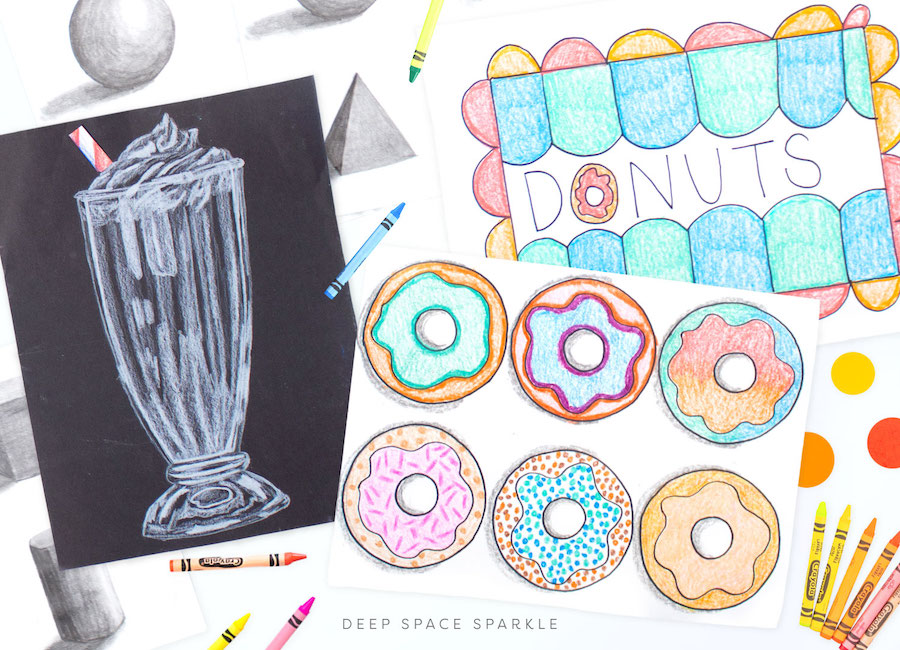
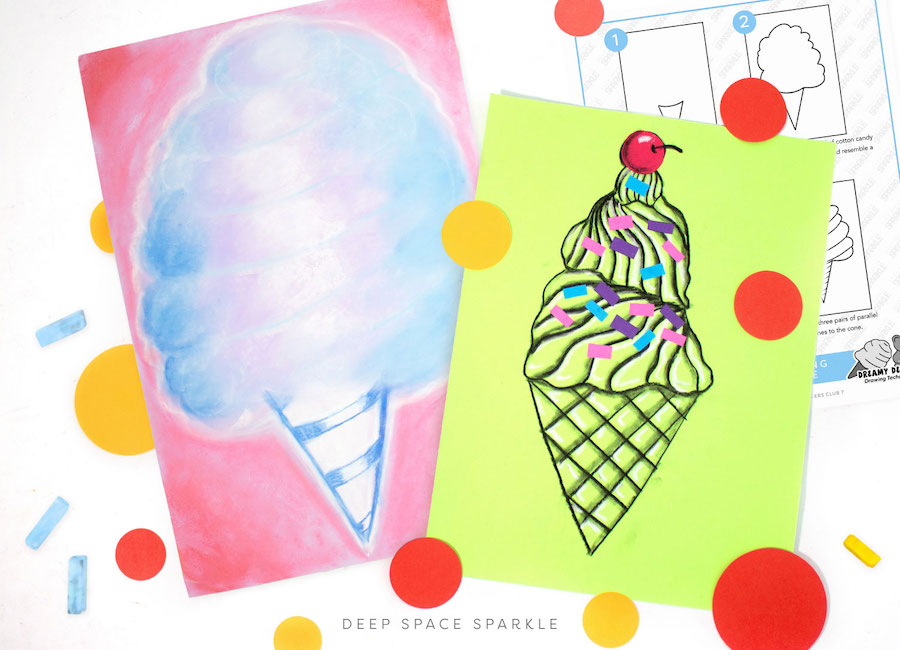
The Dreamy Dessert Drawing Techniques Bundle that was recently released inside The Sparklers’ Club has ten decadent dessert lessons, each focusing on a different medium and technique.
The goal of each lesson is to hone in on one material, from charcoal to colored pencil, and allow students time to explore the characteristics of the material and practice a technique.
These technique focused lessons show implied form using just paper and one or two art supplies, such as box of smooth donuts dotted with sprinkles (crayon), rippled soft serve ice cream in a bumpy waffle cone (charcoal), puffy cotton candy (chalk pastel), ruffles of piped frosting on a cupcake (pen & ink) and a shiny, reflective milkshake glass (white colored pencil).
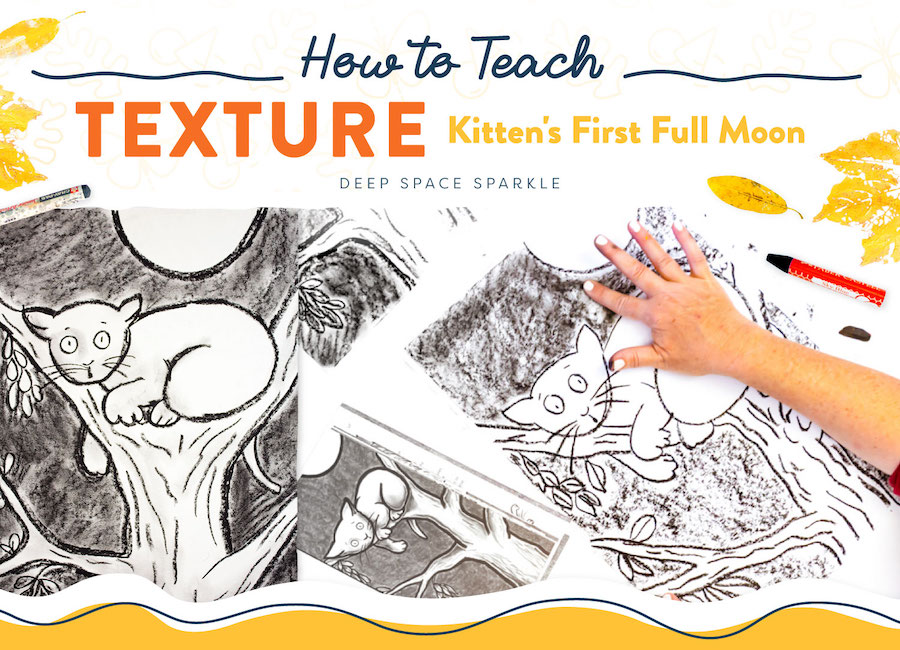
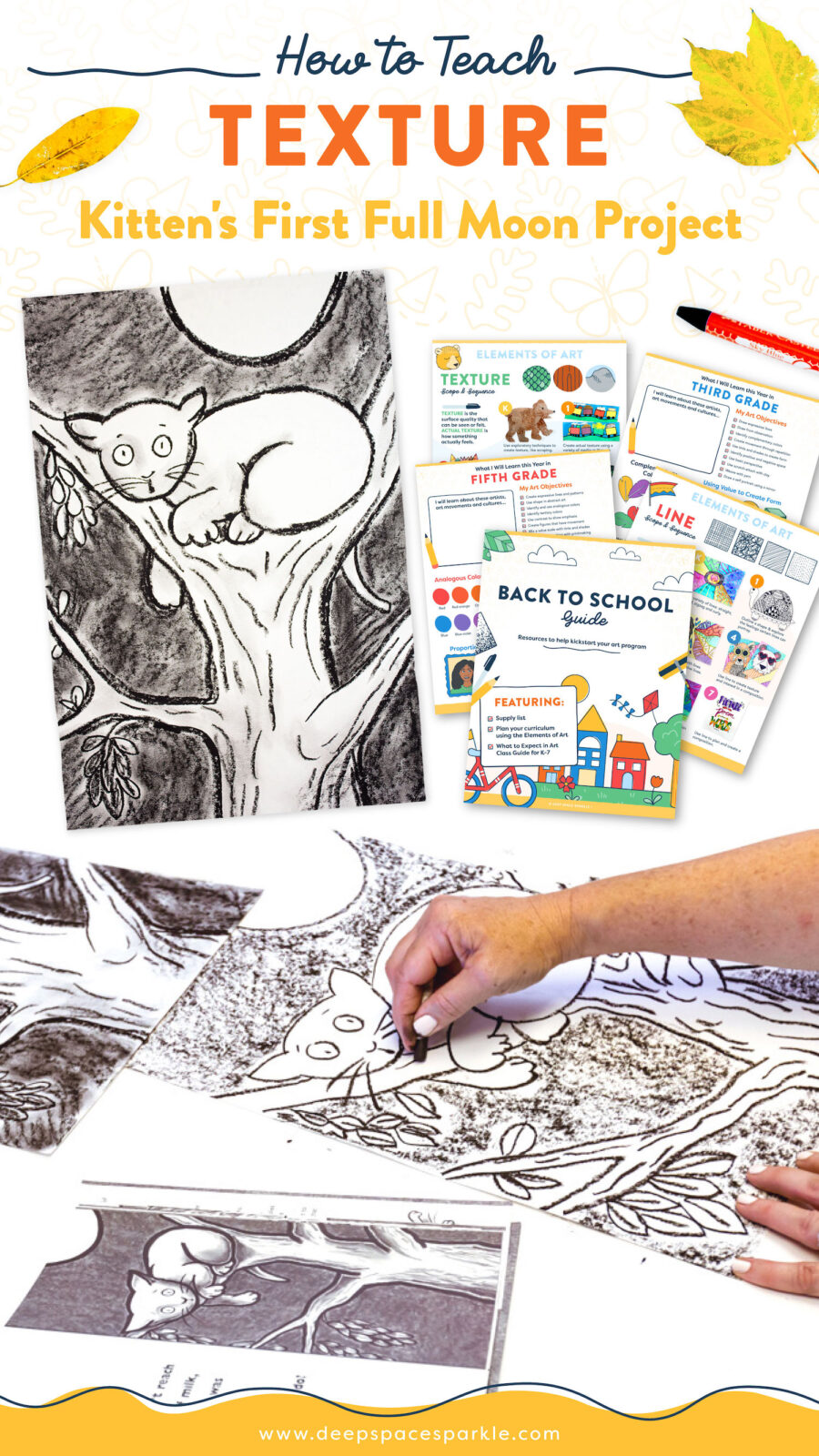
Let’s take a break from delicious desserts and move to a lesson that uses oil pastel to create tree bark that has a rough implied texture. This project is a simple line drawing of the kitten in a tree based on the book, Kitten’s First Full Moon by Kevin Henkes.
Interested in starting your year refreshed, prepared and ready to go?
Download our back to School Guide |Resources to help kickstart your art program

It’s a 3-part strategy on how to use the Elements of Arts when planning your art curriculum including ordering supplies, a grade level checklist for the scope and sequence of K-7 Elements of Art and What I’ll Learn in Art Class posters.
To learn how to teach the Elements of Art to elementary school students, here are a few posts that will get you started:
WHAT YOU’LL NEED:
– 12″ x 18″ white sulphite paper
– Black oil pastel or crayon
– Black chalk pastel or charcoal
THE PROJECT:
To begin, start with a white piece 12″ x 18″ sulphite paper and a black oil pastel. Draw the kitten’s face, ears and eyes first using the black oil pastel or crayon.
Draw the round back that curls into the kitten’s hind leg.
Draw the front paw, then draw the tree branch that the kitten is sitting on. Start the branch from the left edge of the paper.
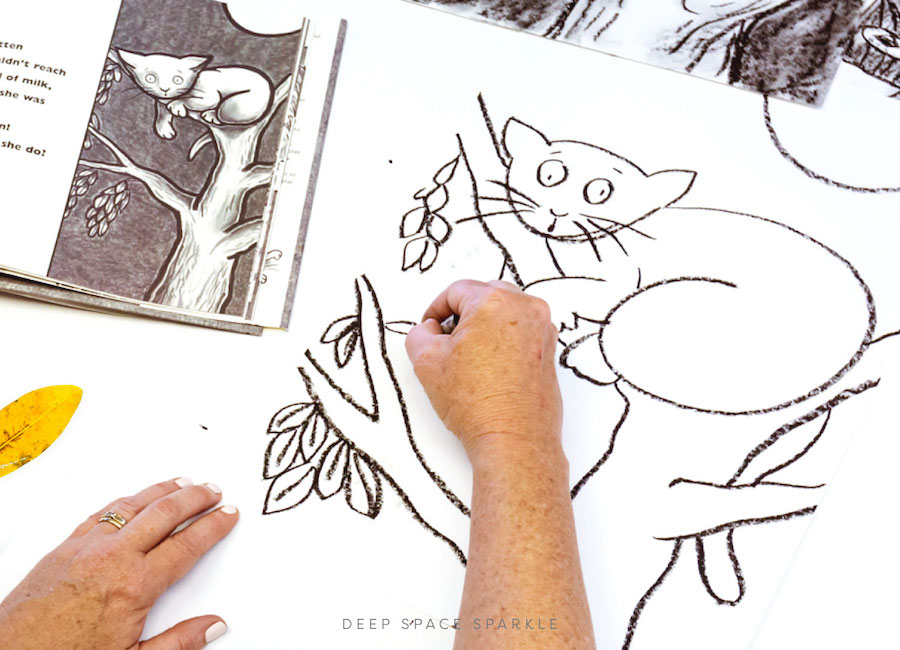
Draw the trunk of the tree, making note to draw the tree trunk with curvy lines as opposed to straight lines.
Once the tree is drawn, go back to the kitten and add a tail and back paw.
Finish the face by drawing the nose and whiskers.
Draw the moon in the top half of the paper. The position of the moon can be determined by the students (behind the kitten, large, small, in the corner, etc.)
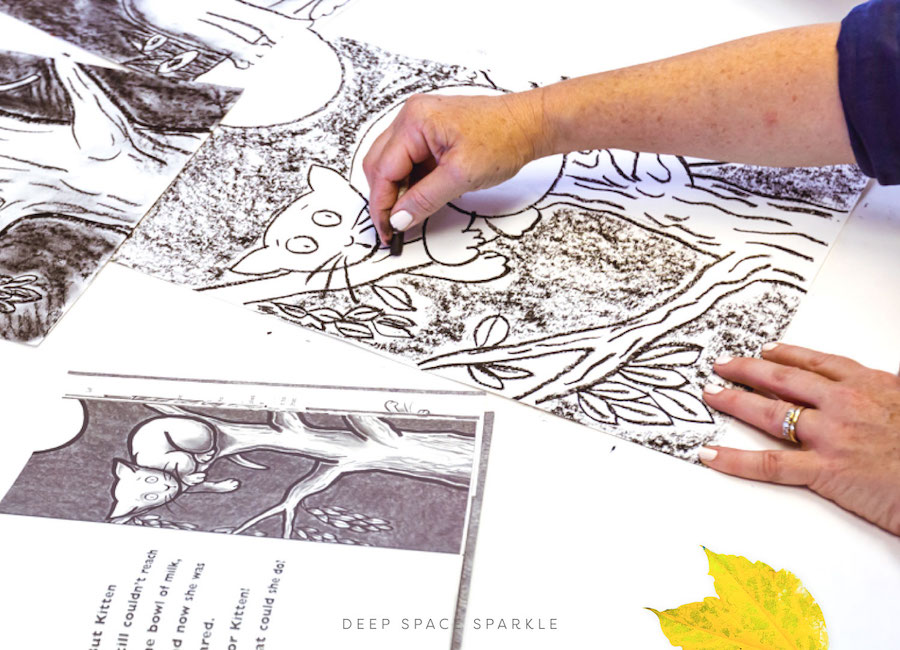
Next, add implied texture by using the oil pastel or crayon to draw wiggly lines in the tree trunk. Draw both long and short lines to represent the rough tree bark. Do you see how adding simple implied texture with line makes the tree look rough and bumpy?
Add lots of leave to the tree branches.
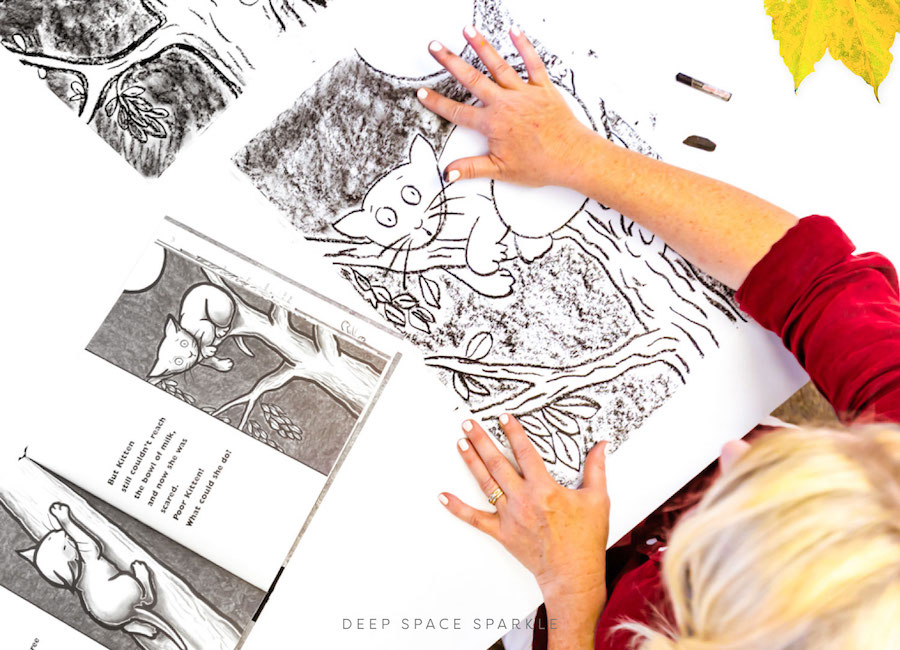
Now pick up the black chalk pastel or charcoal and color in the sky. Use the side of the chalk (break in half so it’s short) and loosely color in the night sky. Use one finger to smudge the black chalk background so it fills in the sky.
The elements of art and principles of design are a great roadmap for teaching art. To see examples and full lesson plans of other simple supply texture lessons, make sure to check out the Dreamy Dessert Drawing Techniques Bundle in The Sparklers’ Club.
For a full curriculum based on the elements and art and principles of design that includes lessons, videos, sketchbooks and more, check out the Elements and Principles Integration Curriculum (EPIC) in the Sparklers’ Club. Not a member? Join the waitlist here.

Thank you, desperate for a library/art lesson and this is perfect and adorable!
Excellent lesson. Concepts clearly taught in lesson which capture’s students’ attention and involvement.
I have 2 grandsons who are trying hard at working on sketching & painting. (their ages are 11 and 7) Any easy tips for shading, shadows, painting water & other easy tips would be greatly appreciated.
There are lots of tips right here on this website. I’d start with selecting a technique from the Art Lesson Library, then search lessons by grade level.
https://www.deepspacesparkle.com/art-supply-technique/
Also, you might be very interested in my book, Draw, Paint, Sparkle Drawing & Painting projects to do at home: http://drawpaintsparkle.com
I want worksheet for elements and principles of art.
Thank you, this will be helpfull
Looks like a great lesson!
Another great lesson for art drop-in at community centre
Thanks for the user-friendly ideas!
You’re welcome! Glad it’s helpful!
Love this texture lesson! If I wanted to add a pop of color to this drawing, where do you suggest it could go and would you use chalk pastel or oil pastel?
Thank you! And great question. Adding a pop of color would be amazing! I would use oil pastel as it tends to smudge less therefore making the POP really POP! Would love to see your project when you finish it. Consider joining the free Dazzler Facebook group > https://www.facebook.com/groups/DSSstudents/
Thank you for the advice. I am already a member of the Facebook group. Waiting for the Sparkler Club to open back up to join!
I am a student of Chatsworth high school I like my art I colouring I struggle in drawing again but art is in my subject as school I would love 1 to 1 lesson to learn how to perfect my drawing. If you could get back to me that will be great. thanks
Nabil Adoko
I like art
Where can I find the PDF instructions of the kitten drawing? Thank you!!
Would love this!
Please send me the PDF for lesson on texture.
Hello,
It seems the lesson plan is no longer available. Is there another place I can find it?
Thank you
Hi Monique, this is Bethany from Team Sparkle. Thanks so much for your interest in this lesson. It looks like the link was broken, sorry. Try again, it should be working now. Enjoy.
I would love to bookmark the Kitten’s First Full Moon lesson. What bundle is it in? I have searched for it but it does not come up.
Hi there,
I’m so happy you like this lesson! It’s a great book, too. We don’t have this lesson inside The Sparklers Club. It’s strictly a free resource.
Is there a pdf?
Hi Mara! The directions are included in the post there is not a pdf download for this lesson. Enjoy.
Hi, I love this lesson and the kittens are just darling. I feel like students don’t look at the moon the same after considering it as a bowl of milk. Messy yes but the messiness works for the image and I like the art in tones of gray the best. Their images relate to the book in that way.
I want toh new lesson plan for higher school
Hi Sheikh! We’re so happy you found us. Many of the lessons in The Sparklers’ Club are based on the elements and principles of art and can be adjusted to fit the needs of older students by offering additional student choices in either materials, subject matter or both. You could also bring up the complexity of lessons by adding more details, opportunities to use observation, and opportunities to infuse personal expression. We hope that helps.
Hi there! I don’t see a PDF to the lesson anymore. Could you relink it?
Hi Caitlin! Thanks so much for your interest in our pdf. Unfortunately this pdf is no longer available.