
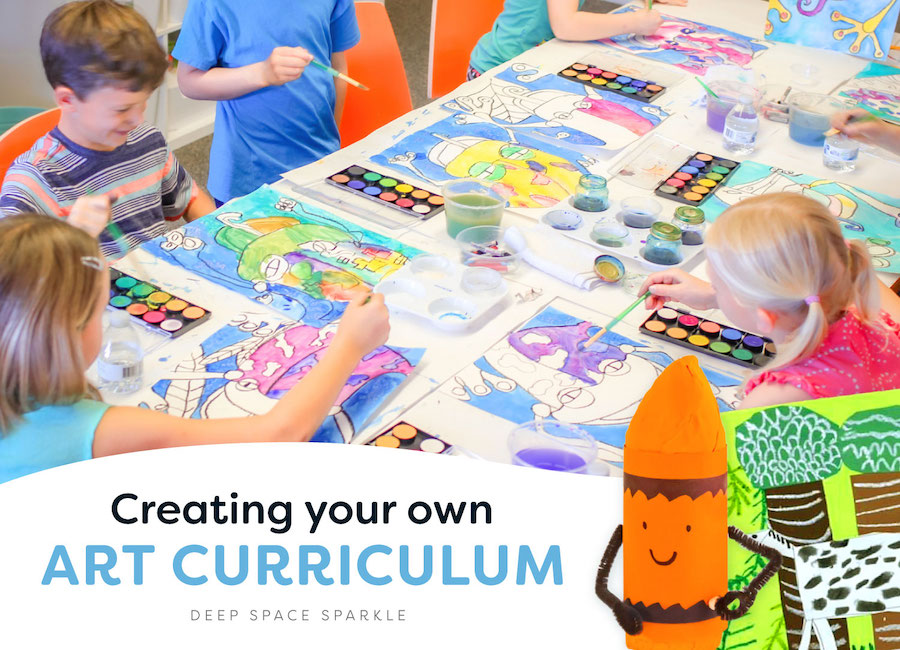




Every year I attempt the same thing: create an art curriculum for my readers. It’s the request I get most often.
New art teachers want to know how to plan our their year. Seasoned teachers want to change things up. Wouldn’t it be great to just print out an art curriculum complete with multiple lessons for each grade?
When I was beginning my career, I felt the exact same way. I had never taught art before so I was overwhelmed at the idea of teaching art lessons to seven grade levels. There were a few art books and a few websites that I pilfered, but I knew I needed a plan.
What kind of art curriculum should I have? Did I need to follow standards? Were there any standards? What about art principles? Did I have to tie into the teacher’s curriculum?
So I asked my Principal, “What do you expect from me?”
He said, “Just do art.”
Hmmmm. Okay.
Borrowing inspiration from the Elements of Art, I tried art lessons that I found interesting. I experimented with differed materials, different papers, different brushes until I found what worked. I took a stab at papier-mâché and 3-D art and lessons from Great Works of Art. I gauged the success of the lessons by the student’s reactions. They provided the direction of my next lesson.
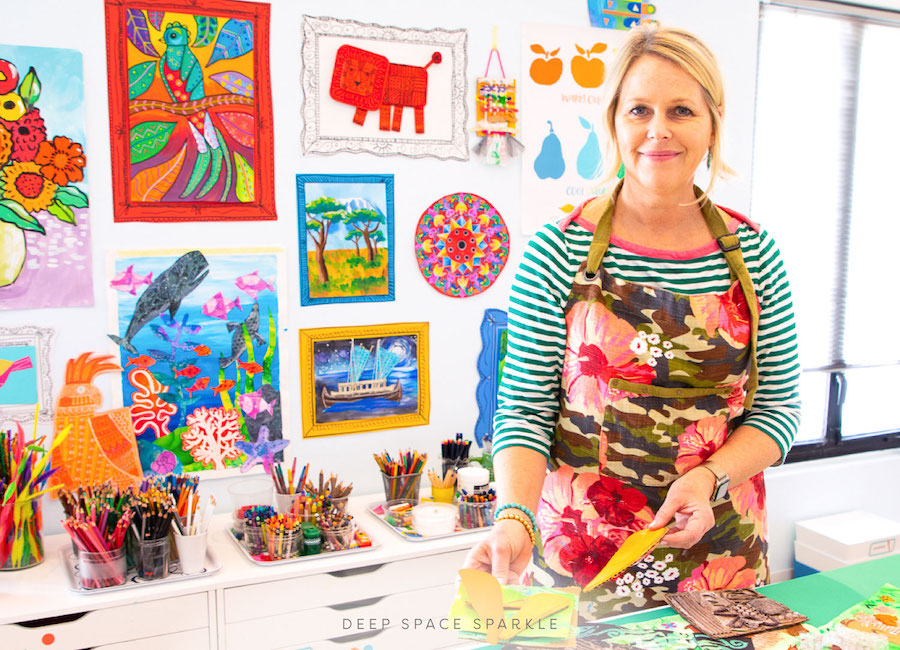
My teaching situation might be different from yours. I feel my job is to introduce children to the world of art, to learn what it means to be creative and to learn some techniques along the way. I don’t grade. I don’t have to follow standards. I don’t get a review. My art program is organic. But I sense that I’m in a unique position and realize that it might not be in the best interests of my students not to have a structured or at least formal art program.
My readers are art educators. You have report cards, unyielding schedules and strict standards. You have stress! So what should you do?
The Perfect Art Curriculum
Here’s the thing: there is no one perfect curriculum.
Some might argue that there should be, but if there were, we wouldn’t have the freedom to experiment. To read a random picture book and be inspired enough to create a lesson around it. To visit a place of geographical significance and turn in into an art project. That’s what drives my love for teaching art. To introduce my students to things in my world, like my home in Prince Edward Island. I’ve incorporated cows, barns, lighthouses and local Maritime artists to my Californian students.
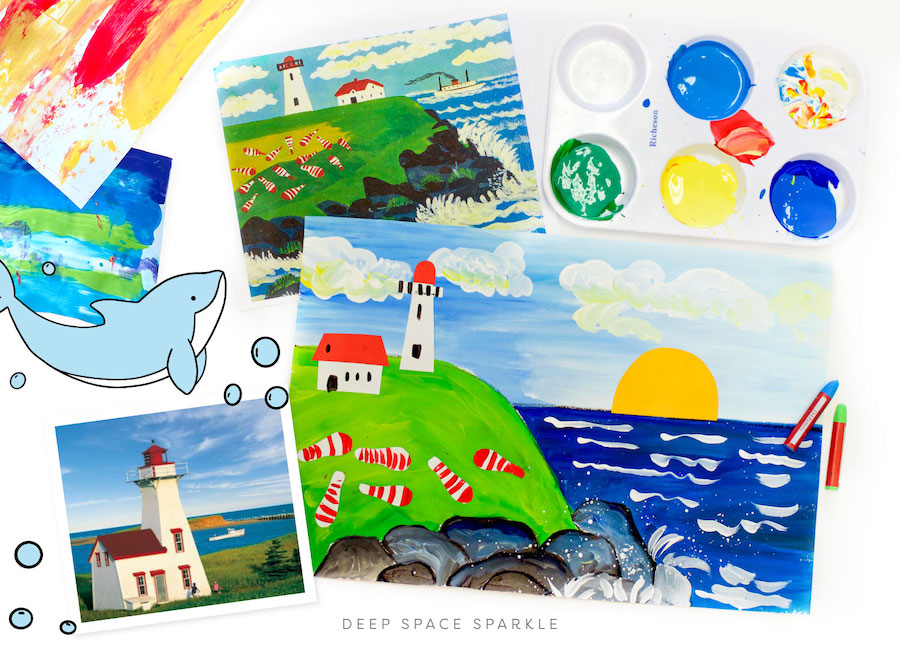
That is what inspired me but I also realize that I’m in a position to teach and therefore, I create an art curriculum. Mine is technique based. Here are the techniques and general guidelines that I employ to every art lesson that I plan.
Kinder – Third Grade Art Techniques & Subjects
– Line Drawings & Directed Line Instruction
– Cutting and Pasting (lots of this!)
– Primary and Secondary Colors (painting and/or collage)
– Free Expression
– Watercolor Introduction (increases in difficulty with grade levels)
– Form-based art (Ceramics)
– Painted Paper (mixing paint and experimenting with textures)
– Drawing & Rendering with Oil Pastel, Crayon or Chalk
– Creating Art with Shapes
– Portraits (K and 1st)
– Modern Artist (1st-3rd)
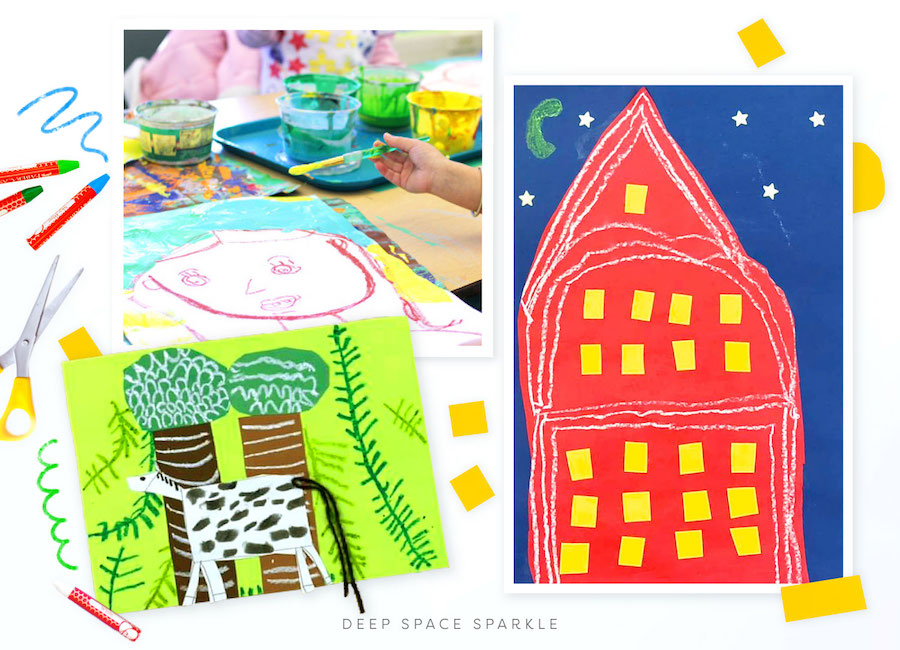
Fourth – Sixth Grade Art Techniques & Subjects
– Drawing & Line Drawing Lessons with Markers
– Watercolor Techniques (resist, salt, lifting, wet-on-wet, wet-on-dry)
– Tempera Painting (mixing paints/tints and tones
– Paper Cutting and Collage
– Form-Based lesson (ceramics)
– Art History (Artist, Culture)
– Oil Pastel Lesson
– Chalk Pastel Lesson
– Portraits (5th)
– Ceramic Tile Mural (6th)
– Modern Artists
– Colored Pencils & Charcoal
It’s far easier for me to outline art techniques rather than any other method such as Principles of Art or Elements of Art. I write all my lessons down in whatever format I find the most useful and make sure that each class has at least one lesson devoted to each technique and subject listed above.
If I have a day full of multiple grade levels, I will often teach the same technique to all of them. I will change the subject matter and teaching style but the technique would be the same. For example, if I did a directed line drawing with my Kinders, I would pick an easy subject. For the older students, I would introduce a higher level of detail. That sort of thing. I never do the same lesson with different grade. Too boring.
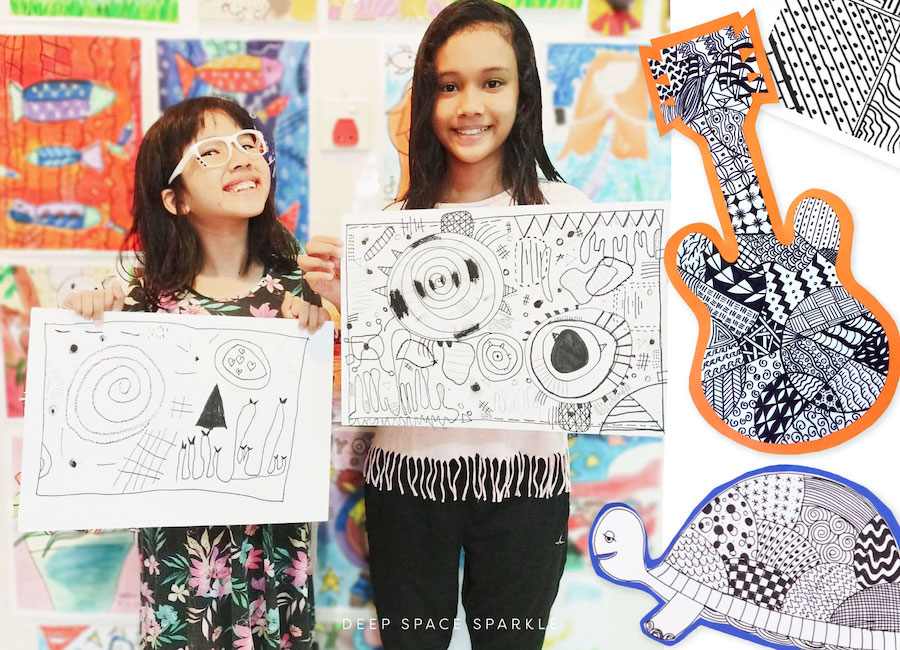
Art Themes and Styles
This is one area that is best left up to an individual teacher’s passions. I’ve found it hard coming up with an age-appropriate art lesson for any of the renaissance artists (although I just recently got some great ideas from a question posted on Facebook). To me, the art is too detailed, too stuffy and has far too many naked bodies!
I do love ancient art, the modern masters, contemporary art, culturally significant art, architecture and basically blasts of color. Creating art lessons based on these areas is very easy for me and by using my checklist, I know that my students are learning everything that they should be.
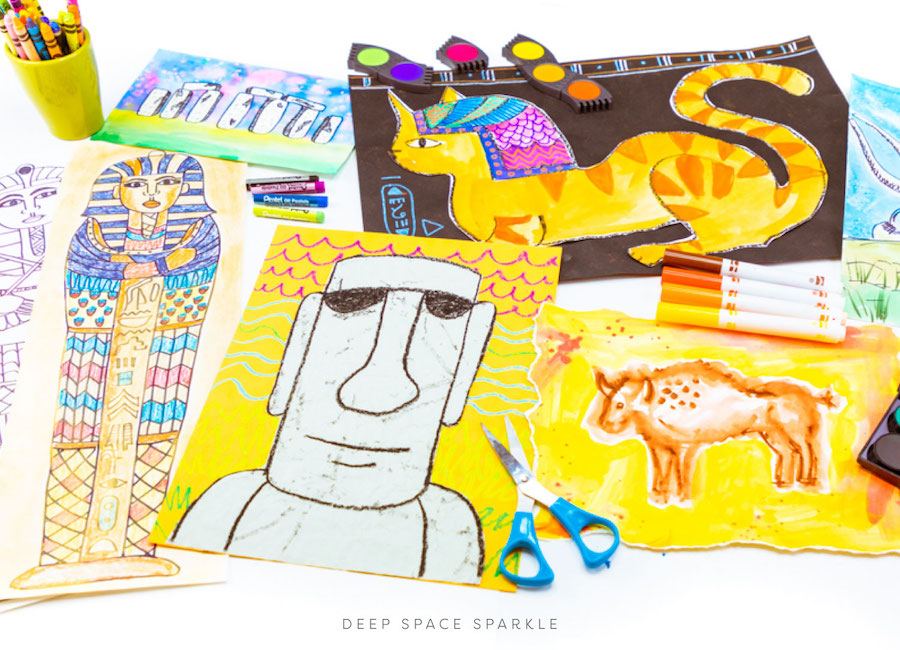
My suggestions for those of you who are struggling to develop a curriculum is to try a few different things. Find what inspires you and excites you to teach. Kids will respond to your enthusiasm. Stay away from anything too serious until you find what your style is. Every single element and art principal can be incorporated into almost any subject and technique. Just play and experiment.
Teaching Styles
If I could teach any grade level all week long, it would be kinders. They are so adorable and they listen so well.
I know. Seems contradictory, doesn’t it? The kinder teachers at my school have done an incredible job with their charges. These little kiddos actually pay attention when I ring my bell. They are rapt with eagerness when embarking on a new lesson. This amount of interest is no small feat. Lots of challenges with different learning styles, attention spans and behavior readiness (is that even a “teacher term”?). I have to hand it to the teachers at Brandon. They are good.
As the children gather, I talk in a low voice, mostly because the excitement level is so off the charts when they arrive, and announce what they will be making. I try not to engage the kinders in questions like “have you ever made a snowman?” because the comments will truly go on forever and soon you will know about every family trip the child has ever taken. Although, if you’re talkative like me, occasionally you too will get carried away and one question will leak out and you’ll have question carnage to deal with.
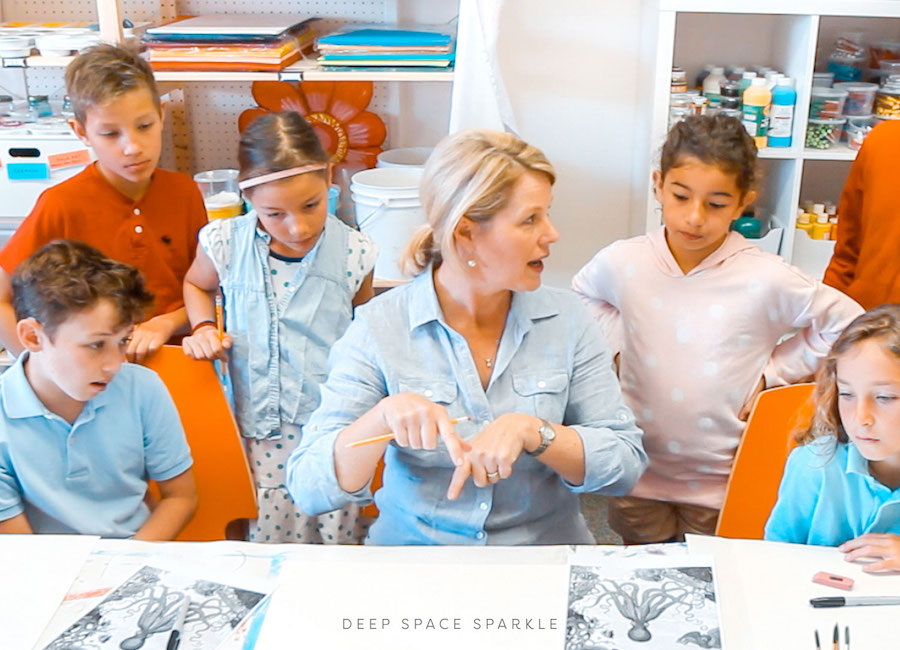
Dealing and interacting with the children up close and personal seems to work well. I can easily address a child who blurts out inappropriately, I see who is paying attention and who is drifting. I can reign in the wigglers by having them sit close to me or stand up or sit down… whatever it takes to refocus them. I try to use engaging words and hand gestures so at the very least, they will look at me and wonder if all art teachers are this weird. I figure I have about 7-9 minutes before I lose the kids. I make every minute count.
Up Close and Personal
Having the children close, really allows you to monitor their reactions, to play up on what they respond to and temper what doesn’t. The close proximity to the demonstration also seems to solidify in their minds the steps required to do the project. With all four kinder classes, very few children needed extra help with the intricate process of scratch-attach and scoring needed for the snowmen. And hardly anyone needed help with the painting. They were good to go, eager and proud of their creations. They loved the process. Mind you, the snowmen are a kind of fail-proof lesson, but still, few kids were frustrated or forgot what to do.
Now, here are my questions for you….
What works for you?
How do you handle a detailed project with little ones?
What works for the older students? Do your students stand as they create or must they sit?
How long do you spend on a demo?
Do you have to stick to a set art curriculum?
What are the biggest obstacles you face in creating your own art curriculum?
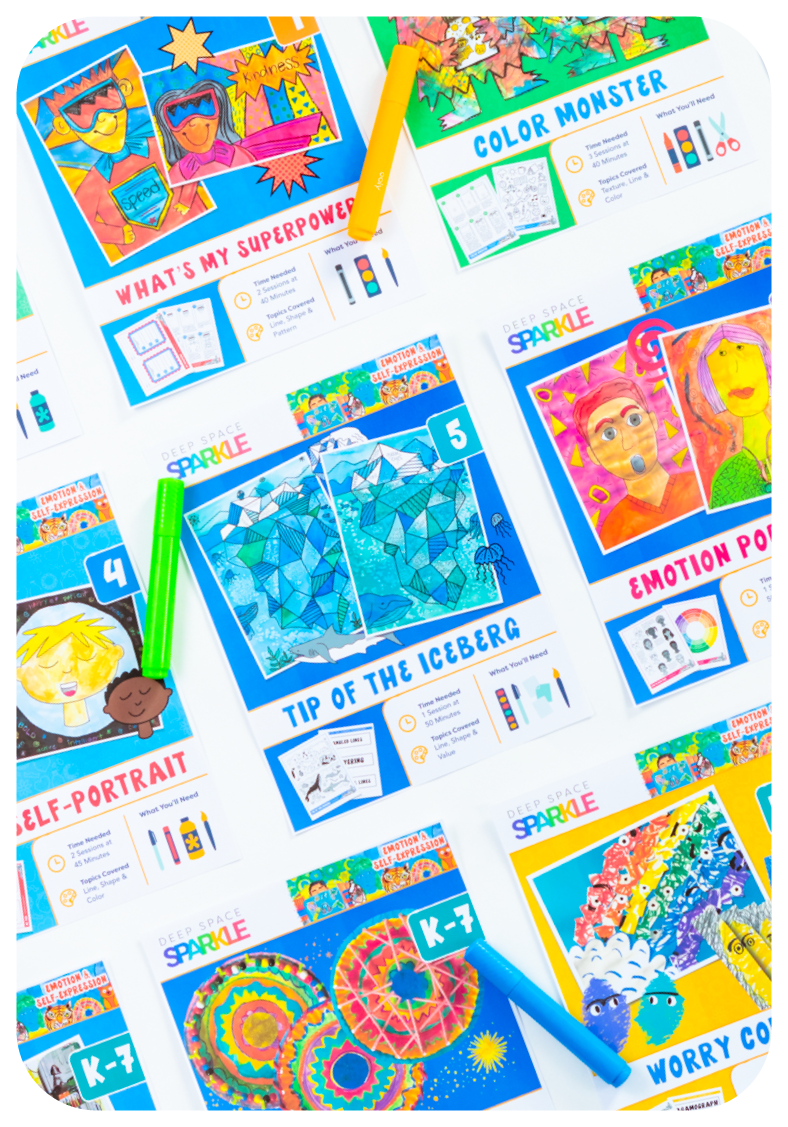
Download the Art Teacher’s Toolkit Guide for success in selecting lessons, planing your curriculum, finding the best art supplies and more!
To hear more information on art curriculum’s, teaching, teacher interviews and starting your own business, check out my podcast Art Made Easy to learn more.

Hi Patty, I find your information helpful and much in line with what I have just planned out. I do not follow a curriculum, I am an after-school employee who is lucky enough to have selected art. I was given my own classroom and told to have fun with the kids while I teach them art. y biggest obstacle is figuring out how much prep to do. I try to let the kids see all that goes into creating a project, but often this leads to unrest in the classroom. I am getting more and more organized as each day goes by. I have 20 in each class, I teach one grade level everyday for 6 weeks ,1 hour a day and three classes on Fridays. I serve 2nd 3rd and 4th grade. I adore your blog and have purchased many of your lesson books. They are fab! Thank you.
We have a set of standards that we are to “follow”–but of course each instructor’s interpretationsof those standards may be different! They are also VERY vague like “students will create an observational work of art”—what KIND of observation? Observing me doing a step-by-step? Observing a still life? Looking at a Masters’ artwork and creating from there? Who knows. I just make sure I hit every benchmark at some point through the year.
My principal expects me to create beautiful work with the kids. I doubt he’s ever even looked at the elementary standards. When I’m observed, he’s more concerned with how engaged the kids are and my delivery rather than content. Crazy, I know. I love, however, that he just lets me “do my thing”–I couldn’t imagine being at a school where the principal hounds you.
The only “obstacle” I face each year is trying to spice things up for my kids. I get bored teaching the same lesson over and over every day for a week and then repeating the next year. But this also brings on another obstacle: REMEMBERING to recycle lessons you used a few years prior! I see so many cool things on the internet that I forget to reuse some of my awesome lessons that worked!
This is so helpful, thank you!j
It seems that you and I Joanna, have similar situations. I too get bored with doing the same lessons so mostly I don’t. I pick some of my absolute faves and then invent new ones. I love creating lessons. Probably why I love this blog so much!
Have a great year and try Pinterest for keeping all your “internet” ideas in one handy place. It’s SO useful.
I homeschool 3 children, grades K, 2nd, and 7th. I am not an art teacher. I struggle with including art into our already busy curriculum. While it is easier to do crafts, I really want my children to learn art techniques, styles of art, etc. I am determined to include art into our curriculum this year. I am hoping that once I get into it, I will feel more comfortable with it (I’m a geologist by education:)). I love your site and will likely utilize some of your ideas because they seem do-able. ANy ideas are greatly appreciated!
I so hear what you are saying! Teaching art comes easy for me and it’s what I love so thats why I started this blog. You should be able to find a few lessons on my blog that are detailed enough to incorporate into your curriculum without too much stress or worry. If not, I think my Art Booklets (available in SHOP) will be even better. The “Watercolor Projects” would be perfect as it gives a good age range of projects and will show you how to draw the pieces and teach some watercolor techniques. Might be worth trying.
Hope this helps!
Hi Patty, I have total freedom at my 2 small private schools. This is my 3rd year.I have preschool children up to 8th grade. This year I really am trying to go by some sort of guide. I sorted all my fav artist and project I want to cover. Then I spilt my calender between seasonal and event like Histpanic Heritage and Black History month. My school expects me to decorate for 2 big shows and the special events. I always make sure each class has something up for the shows. It has gotten easier as I have evolved in my ways of teaching. Even my class rules have change they are now only 5. My first year I had a very long list and I use to have a very red face! It still amazes me how pencil and paper on drawing days are the most rewarding. I always show them the books I use and tell them they can find them at the library. Today we did Ed Emberely his way is so simple and easy and the kids love it. I have loved your site since day one. Thanks for all the great tutorials.
Love Ed Emberely! Such a great way to learn to draw. Thanks for sharing.
I am also a home schooler…so what I do is up to me. We used home school materials from Artistic Pursuits for some of our lessons but then I found your website and other sites and that opened up a whole new world. Now I do art at home and for our coop….
I do have advice for Teri….tell your kids that you are not comfortable with this and then go and do it with them…as they work on projects do them too! My kids love seeing what I do and sometimes they are miles ahead of me. We have a good time. I tell them all the time that art is not about getting it perfect…it is about trying new things and seeing if they work…. Spend the money getting supplies and find a way to let it be a little messy- we do art outside when it is nice..
-Joanne
Excellent, excellent advice. You are exactly right. Many of the classroom teachers I work with sit down with their students and follow right along with the lesson. Some struggle and giggle at their attempts. The kids LOVE this.
I am curious…how do you do a direct line instruction with your kinders without a handful of them getting off task, roaming around the room and or talking over you constantly? I just finished a direct line drawing with them over different types of line on their second day of art and it was needless to say exhaustingly challenging while feeling mildly unfocused…although most their artwork did turn out pretty on point.
Great question! Well, there are many ways to approach a directed line drawing. In many ways it comes down to just how well you interact and relate to the kids. Because I can illustrate well enough to excite a bunch of 5-year olds, I “draw” them in by showing them what we will be working on. If you can engage them, you’re golden. It’s almost never about “sit down and do what I do” (which I suspect isn’t what any of us really do) but we have to make sure we don’t come across that way.
I offer alot of encouragement, try to giggle at my own “mistakes” and really just try and make the experience fun and risk-free. Sounds all fine and dandy but the truth is, it takes practice.
My kinders are some of the easiest groups to work with because I really feel like they walk into the art room with more enthusiasm than I can contain. They bubble over with energy and once they taste their first moment of “I can do this!!!!”…you’ve hooked them for the entire year.
Kinders are a challenge. Each year you forget because by the end of the year they are following along so great. I do a lot of “song and dance” so to say to draw them in. If I am having them try to follow along I often have to get them all paying attention, like you said they are talking out loud, or off task. I will often have everyone put their hands on their head when they are ready to go on. You can also have them repeat after you with a silly rhyme that goes along with what you are teaching. Talk to them and present things like they are magical, fun and exciting. The first few weeks are the trickiest with the little ones. You really need to enforce the rules while keeping their attention at the same time making it fun and engaging. I do a great lesson at the beginning of each year with line for my kinders and first graders. We sing the different types of line to the song of ” wheels on the bus” I have them repeat each line after me and we draw in the air or on the table with our finger as we sing the song. Then we put it all together and run through it . Next we draw them on paper. Here is the song if you are interested. A curved line arcs all around, A wavy line bumps up and down, A zigzag line has points you see, won’t you sing along with me. A spiral line goes round and round, a broken line will skip the ground, some are thick and some are thin, lines can do so many things. A vertical line goes up and down, A horizontal line lies on the ground, diagonal lines slant side to side and that’s what I know about lines. Good luck and have fun with it. You can change up the accents for the first graders they like to sing it western style, British accent, robot, what ever you can think of. There is also a cute lesson on the internet about a monster that comes to school that teaches the rules. I took the story and changed the words to fit into the art room that gave specific good and bad choices to teach my art room rules. Then we talk about not being an art monster when we come to art. Also there is a simple follow along monster drawing you can do with crayons and one paint color (crayon resist). I just started with this lesson myself this past week. Then when the students break a rule I reference the story about making good choices and not to act like the art monster. I borrowed this idea from an awesome teacher I saw on Artsonia from Ceeder Creek Elementary, Linda Welling (Not sure on the spelling ) and adapted it for my needs. Between Patty’s Deep Space Sparkle and searching through Artsonia I have found so many wonderful lessons and ideas. Love to share and find new inspiration on here from all the comments and blogs.
Jenn, thank you for sharing I’m going to teach that song to my k classes!
Pattratioanaley,
I have been teaching art for 35 years, and I have never heard anyone put into words, the way to create and use an art curriculum as succinctly as you have. I really appreciate your time in explaining your rationale and why it works for you. I also believe that you basically stated the beliefs of what I hope are a lot of art teachers out there. We create our currriculums in a manner that works for us, no matter what kind of teaching situation you find yourself in. I just spent innumerable hours last school year with the art teachers in my district “revising” our art curriculum. Our district felt the need to place the visual art teachers under an umbrella with band, vocal music and drama teachers as, The Fine Arts. We were led in our discusssions by a retired band instructor who has an advanced degree in what, I’m not sure. He is a very nice man, but know zip about visual art. Needless to say, he pretty much discarded what the visual art people wanted and pulled info off of the internet from other school districts around the country to cut and paste our curriculum. All of my colleagues in the visual arts gave a wink and a nod to acknowledge that we will continue to teach our students the way we feel is best for them as well as our programs. No one in administration ever questions what we do as long as our children produce art projects that can enliven our buildings and district office. I am very proud of my students artwork and their work has received numerous awards so I know I am doing something right. I have been following your blog as well as many others and have added so many exciting projects to my repertoire over the past year. Keep inspiring us, Patty. We need it! And Jenn, you rock! I am so using that song with my kinders next week! Thanks!
Pat:)
sharpiewoman.blogspot.com
THANK YOU so much! It’s kind of a double edge sword; I wish my district would consider art more integral to the overall curriculum but on the other hand, I love having the flexibility (and trust) to create my own program. Hard to find the perfect balance.
Patty sorry about your name in my post-it was blogger, not me!Ha!
Patty,
I am sorry that blogger screwed up the spelling of your name in my last post!
:)Pat
No problem!
I appreciate all of your thoughts. I am a Homeschool mom and use your site as a resource a lot!!
Great post Patty! I get weekly emails from homeschoolers asking for a complete art curriculum and now I should just send them the link to this post! Well said Patty and great summary of techniques to cover.
I think everyone needs to do what works for them and when I was teaching I liked to mix it up every year so the kids and I didn’t get bored. Teachers and parents like to see different projects show up in the hallway displays from year to year too! Of course it’s fun to have a couple of “classic” projects for each grade level that everyone looks forward to (for example my First Graders always made Clay Frogs and it was hugely popular) : )
-MaryLea (pink and green mama)
Hi Marylea…I so hear you! It’s a very common question and I hope I was able to help some of my readers. And you’re right, teachers and parents want to see different projects. What you said about the “classics” is also true…I think that would make a great post!
I have been teaching elementary art for 11 years now. I have a set of vague standards to follow, but no one is very fussed about whether or not I follow them. I have built my lessons around exploration of media and creative expression in k-2, elements of design in 3-4, and principles of design in 5-6. That being said, there is a lot of room for straying off that path whenever the mood or inspiration takes me. The kids are happy to follow me into new lesson ideas and the work they do is always highly praised by parents and the principal alike. My main goal as an art teacher is to have the kids leave my school with a ‘can do’ attitude about art so they will be more likely to sign up for the optional/elective art classes in secondary school. I want them to love it, live it, and accept the fact that there is an artist inside them!
I have to agree Patty! I am only on my 3rd year, but already I have used SOME projects again that were a hite, but like to integrate new projects. I get bored and I am sure the kids would, too. I am at a private school and also have no curriculum or guidelines to follow. I wish I had something to go by to be sure I am not missing something important. BUT, I do love the ability to “do what I want.” Your list above is a great tool and guide for teachers to compare with what they are doing. THANKS!
Hi Patty!
I teach in two schools: one is public, part-time, elementary K-5. The other is a private catholic school, Pre-K-8.
Do you have to stick to a set curriculum?
In the public school we have a curriculum that is based on the elements of art and techniques. (I wish we had a link, but not yet) Our curriculum has goals, like in K ‘know 8 basic colors, can mix secondary from primary” and so on. We are allowed to teach it in any way we choose. As with any public school, we are required to “meet the standards” but Maine just revamped theirs and they are much better now. Our curriculum spirals in that we may introduce flat watercolor wash one year, wet to wet the next, etc….
In the private school I can do anything I want. So, naturally, I use the curriculum I helped write in the public school. I do vary lessons to contain religious icons, etc.
Do you have the freedom (like me) to create your own curriculum and lessons?
Pretty much, since I helped write the district curriculum!
What are the biggest obstacles you face in creating your own curriculum?
I want to keep lessons fresh. I don’t want to be the teacher whose grand-students come to school and say “My mom did that when you were her teacher!” There are some lessons I do each year, simply because they teach technique, idea well and students love them. I ran into a 25 year old who said she still had her drawing based on Picassso’s 3 Musicians she made in third grade!
Most importantly, I try to teach creative thinking by offering lessons that use their imagination. There is so much instant access, etc. that students are loosing the opportunity to think creatively on their own.
I needed to read this article. Being a seasoned art teacher in private schools my entire career I have never been asked to write anything fancy in terms of curriculum mapping. Until now, drum roll please! I’m sitting here going crazy trying to put all the wonderful things I have been doing for so many years into a document that no one will probably ever read. It is making me want to retire! That’s a pretty strong statement from someone who loves what she does and has been praised for the work she’s been able to get from her students. So yes it’s nice to know there are other art teachers like me out there. I was starting to think there was something wrong with me!
Patty,
I LOVE your site! I get A LOT of my lessons from you. I taught regular ed, mostly 5th grade for years until our Art teacher retired 4 years ago. He did some really great stuff but I needed fresh new ideas and you have so many. I love them! Now I have just received a SMART board for my classroom and was wondering if any other art teachers out there have one. If anyone has any suggestions I would love the help.
Thanks, Heather
Your website are very educational and inspirational even when I do not have an art classroom this year!!!! Waaahhh I miss my classroom. This year I am traveling by room by room its driving me nuts and it’s only the second week!!! The classrooms are small filled with about thirty kids. I am exhausted and overwhelm.
Oh, I’m so sorry. The loss of a classroom is devastating!
Hi Patty! I teach in Ontario and we have a set curriculum that is very overwhelming for us non-specialists. We’re expected to teach our own visual arts, music, drama, and dance, as well as all the other standard subjects. We have 120 minutes a week to teach the Arts and must report on each strand at least once. Drama and dance were originally together but are no longer. I find it a real challenge and love checking out your site and a couple of others for inspiration. Then I go back and see how the project fits with what I’m teaching. Integrating the arts with language and math always helps but can be difficult. If it’s something I really want my class to learn or experience, I find a way to make it fit the curriculum. Thanks for all your advice and ideas!
Unfortunately, there are no elementary public school art teachers in my area (Alameda, CA)
So, I started a business.
I teach art camps, classes and parties for ages 5-11.
This year, I’ve planned my curriculum with these new things in mind:
21 Century Skills
Life Skills
Design Thinking
Entrepreneurial Skills for Artists
I also want to emphasize making arts learning visible in our displays.
Hi Patty
I have recently opened up art classes at my residence….and there are 2 batches of kids…First is 4-7 and second is 8-13….now my queries are:
1.what should be the basic art techniques for both the groups….as i teach them line, strokes, shapes,types of shading….so do you think i should be teaching the younger children these things or just let them do some free styles initially.
2 .I wanted to know what should be some of the topics/subjects which i can teach the kids according to the age group and according to the current trends….which children usually love to draw and paint..
3.Should i start with fruit and vegetable drawings initiallly…if so,then should i teach it to the elder students as well..?
4.What and how exactly should i give home practices to the children…
5. And finally could you please suggest me some other ways to make the art class more interesting and happening so that children dont get bored easily.
Hope to get some piece of suggestions out of your expertise….
Hi Peeu,
Well, you certainly have come to the right place.
I would suggest you start by reading this page: https://www.deepspacesparkle.com/start-here/
Then, I would progress through the menu bar to find topics that might interest you. I know you are probably looking for a simple answer from me, but there are just so many things to consider. I would also look under this category for interesting posts: https://www.deepspacesparkle.com/category/teaching-philosophies/
Hope this helps!
Patty
Hi Patty
I went through your site….its just wonderful and i got most of my answers i was looking for…. your tips are proving very handy and useful to me..
Thanks and regards…
Peeu
For the past 2 years I have been able to do what ever projects I wanted without a set curriculum. We explored materials, artist and different cultures. By the end of this year I have to turn in a month to month curriculum outline listing the big picture for each month and what artists I will be highlighting for each grade. I have to develop rubrics for each project and record grades.
I am really struggling with this. I don’t know how I want to organize my curriculum. It seems easiest to organize it by the elements of art. But that feels so limiting. Any suggestions?
Hi Tara,
Outlining curriculums can get a bit crazy. I don’t mean to sound sales-ey but have you looked at my curriculum planner for art teachers? It’s my solution to coming up with a sane approach to curriculum planning. I show you how I create my curriculum and then I give you tools for developing yours. Here’s a link:https://www.deepspacesparkle.com/shop/art-teachers-curriculum-workbook/
Your site is a Godsend! I’m beginning this semester teaching Art at my boys’ small private school (Music is 1st semester, Art 2nd), and was stressing out about ‘continuity’ in my lessons. It’s not a requirement, but I thought it might be easier…except I don’t know which of the numerous categories to go with for kirigami and origami. But now I think I’m not worried about it. We’ll do this…then who knows. I love the masters and learning techniques, but it’s not always the best/easiest thing to teach little ones for an untrained dabbler…um, teacher. I’m not professionally trained as a teacher or artist, but I have enough background and the willingness. My ‘classroom’ is the back corner of the school cafeteria, next to the 6th grade history class that is behind dividers, while lunch is going on through my first two classes. My new “theme” is going to be Keep It Simple! My focus needs to be more on helping my “But I’m baaaaaaad at art!” students find areas they CAN do well in and developing basic techniques so they aren’t as scared to delve into exploring alternative forms of art. Thank you!
Hi Patty!
I have been looking through your website and love it. I also just read that indicates you are from Prince Edward Island. I am also. What part are you from?
Art has always been important to me since I was very little. We would go to the Confederation Center for the Arts in Charlottetown and spend most of a day looking and learning about the beautiful art. I work at a wonderful College and recently completed my Associates in Arts. I plan to work on my Bachelor’s next.
I am also very lucky to be able to teach art one day a week. I was a little nervous at first because I prefer to have a plan to follow and I could not find good art cirriculums I could teach from. In the end I combed all the books I have and changed/ created my lessons from several sources.
It took me a while to realize that I am doing something I am passionate about. Keeping the “A” (for Arts) in STEM. Art is important to all of us – creative arts (both art and music) are needed in this world. To children and adults.
Now and then, here and there I find time to squeeze in creating my own art.
I would love to chat sometime of home.
Blessings to you.
hi,
Is there any specific age and sequence to introduce the paints (oil pastels/ acrylic/ tempara)? And is there a sequential order for the lesson plans, like the line drawings first and then a specific topic or can we go as we wish?
Do the lessons in this teaching art course cover all the concepts of painting? if no, how could we learn the other concepts?
I just landed a job in Arizona as an “all school” art teacher k-8. I have around 700 students. I inherited a classroom of supplies, but am overwhelmed as how to deliver meaningful, art appropriate information in 35-40 minutes. Sometimes there is no prep between classes, it can be overwhelming with all the different ages and abilities…2nd then 6th, 3rd, 4 and 5th. I also get K,1,6,7,8. I have been here a week and am very overwhelmed as to how this can be done by one person? I have no smartboard yet, limited books, lots of supplies….but I thought maybe start from the elements of art and go from there. I would just like a pre made curriculum at this point…
Make sure to attend the webinar and not only will you learn some strategies, but I can show you how The Members Club can help you (pretty much give you an art curriculum/lesson plans!).
Hi Patty , I was browsing through your blog as I will be starting as an art teacher in the fall, and was looking for ideas. I was intrigued to see the light house and hear you’re from my fair island of PEI. Very cool. Thanks for your suggestions on ways to get started with my curriculum this year.
thank you for this article. i mean thank you.
im in a process of opening my own extra mural art lessons in the ghetto(South Africa) where im from and i was worried about the curriculum im going to use. this really helped me open my eyes and expand my creating juices.
i am an Early Childhood Development practitioner and very passionate about art and teaching kinders.
thank you once again i will be visiting this site regularly. #onelove
Let us know if you need any help! You are awesome!
Excellent advise! Thank you
This is profound curriculum .
Am a professional artist I like enrolled in your club.
Such great advice* Your organic form of teaching based on the students’ engagement is commendable. A natural way it’s rewarding for all, especially you.
Kudo’s and thanks so much for sharing!
Thank you. Valuable information for someone (like me) who is in the process of planning/starting an art school!!
I like the way you have used ‘technique’ to guide your curriculum.
Thanks, this helped a lot. I am starting to teach from home and I wasn’t sure where to start. so thank you!
This was so helpful!! I’m starting from scratch and the school has not had an art program. I am looking for a curriculum k through 6 and would like to know what is the easiest way to get the rescources needed to have an amazing art program. Do i ask the children to purchase things or do i charge an art fee and purchase materials myself? What is the easiest way? I need all the help I can get.
I’m a 12 year first grade teacher who happens to be an artist as well! I’ve been handed my dream job— same school— to start an art program and teach art all day to k-2 students. My excitement and anxiety are keeping me spinning! Your article goes straight to the heart of my upcoming school year. I will not have to follow standards, no grades, but there is no protocol for me to look to. My summer so far is just me scouring the internet for how to plan the next few minutes months. I have lots of ideas to connect art to text as that is something I’ve done in my classroom easily for years. Any suggestions are welcomed as I begin this new journey of my teaching career.
I’m stepping into art education , looking for lesson plan , art history and appreciation ideas for K-6. Your article has great info I can use. Pls let me know how to become a member.
Hi Puja! If you click this link, add your name and email, we will send you information in about 2 weeks. https://deepspacesparkle.lpages.co/the-sparklers-club-waitlist/ Hope to see you in the club!
Love your advice, encouragement, ideas and experience. I am a 10 year long teacher, but I switched from middle school to elementary and I have a lot of growing to do. Thanks for the info…. 🙂
My problem is finding a lesson that is adaptable for K-8th grade. New teacher, never been in a classroom or had any education courses. Going the alternative route so I’m basically figuring it out as I go!
Oh, we can help you there! Make sure to sign up for one of our free workshops (Jan 3-10) or start watching the free videos on the DSS facebook page. And don’t hesitate to ask questions. I love helping our new art teachers!
Thank you for your website. I found it very helpful. I also have worked with Kindergarteners and love teaching them! I’ve learned from a master teacher how to do directed drawing with them and let them watercolor or color in what we draw with crayons, markers, etc. I am considering a job where I would teach K-8th grade Art in a small private school. I like how you outlined what different subjects to gear lessons around for various grade levels. Do you have anymore detailed instructions on how to do various art projects? If you do I would love to check this out. Also what was the average amount of time you would give children to finish projects? K-2 I would guess 1 to 2 days with short attention spans, depending on the project of course! Then 3-6th grade, a weeks maybe and 7 & 8th graders 2 weeks depending on project? Also I know from teaching “Kinders” the way to keep children engaged is to not have a lot of time where they’re not busy! What did you have your children do that were finished way ahead of the rest of the class? In Kindergarten, I always had a shelf behind each literature center ( Which is an academic learning center time that incorporates math, reading and language skills, as well as Science, writing, hands-on etc. ) So if child finishes let’s say a line drawing and watercolor painting. Then they could either do an art center with play dough, color rubbing, Etch a sketch, etc. At the same time I don’t want them to hurry through their work to get to the “playing fun-center. “ So if you have any suggestions for that like free draw, creation station with construction paper, used from scraps, that would be great! Thanks!
Hi Carrie!
We have loads of support for you here. I did a quick search on my podcast for Early Finisher posts and I came up with this: https://www.deepspacesparkle.com/?s=early+finishers
Also, I would encourage you to join our Deep Space Sparkle Dazzlers Facebook group to ask these questions. The group is amazing and no doubt you’ll get lots of responses to your questions 🙂
https://www.facebook.com/groups/DSSstudents/
Thank you! You have inspired me to create an art curriculum in a safe, comfortable, my style kind of way! I appreciate that so much!
Hello! I just read your page on here and it makes a lot of sense. I am trying to develop my own K-12 art curriculum as well. I appreciate any advice!
Hi. I taught pottery as an extra mural and due to the Covid-19 situation have recently needed to move into the online teaching arena and away from ceramics. I need to develop an art curriculum and had been wanting to combine some theory..so an educational component (just an overview) but then followed up with a practical art project (for example if we touched on picasso-cover basics facts and then the kids make their own interpretation of the style. When it comes to pottery I am very comfortable and have a similar structure as you. I teach one handbuilding technique per term, but the kids make different projects using that technique. I am a self taught artist and love mixing mediums and trying new things, which is why I had thought of building a curriculum that touches on various techniques and mediums, ranging from drawing (such as the Picasso style project idea) to perhaps an air dry clay project (they will most likely not have access to a kiln and they are in another country so I obviously wouldn’t be able to fire their projects so would need to use an alternative medium other than earthenware clay). My concern is that when it comes to teaching pottery, I am very hands on with my students, especially the little ones and am very nervous about how certain projects will translate to the online environment. How feasible do you think it would be to teach art online when it really is such a hands on process? This “concern” will obviously have a large impact on the kinds of projects and artworks I would be able to do with the students and how I set up the curriculum. Do you have any advice or suggestions on what to stay away from and the kinds of projects that would translate well online? Thanks very much.
Hi Pam,
I love your thought process here. As a seasoned business owner, I can share that the most important thing to do is experiment and see what works for your business. The answers in your questions are in the doing…
I love this! My school might be getting critiqued by the acsi team and we might be getting checked on our curriculum and if we are teaching what we need to be; not sure if that is cancelled due to covid though. I just thought I would be on the safe side just in case they do come. Thank you so much! Do you have any suggestions on art games to learn movements, color theory, artists for prek-5th grade? Thanks in advance.
First of all I Thank you for sharing your ideas.It is very useful for me.
Just what I’ve started….thanks for sharing your insights!
This has really been helpful, thank you. I have recently taken on a position teaching KS2 & KS3 art classes. I volunteered a couple of years ago and have now been asked to teach.
I am in the midst of working on a curriculum. Hearing how you have achieved this and the techniques and advice you have given has really inspired me. Thank you again.
So helpful. Thank you so much.
This looks like a wonderful plan!
This was super helpful to get my brain going. I am a BRAND NEW art teacher for a school who hasn’t had an art teacher in over 9 years. Your page will definitely be my new bible to getting started and not being afraid to fail. No matter what we do, the kids and myself will get the amazing experience of trying, failing, and succeeding at art! So thank you!
Thank you, great info. I feel that we have the same mind set.
I am just getting started. Where do I begin?
I understand you well. And I also enjoy how you explained about creating your own curriculum. I will always follow you patty I been teaching for over five years. But now, I want to establish my own art school in Liberia West Africa
Thank you. Possibly taking over art position due to surgery.
Great tips!!
Please explain to me the different membership. I am interested in rejoining. However I forget how this works and much each membership costs and which each membership offers. Thank you
Hello! I ran across this information from google! I am a new arts and crafts director trying to create my very own curriculum and need a little guidance! Please reach out if you can by my email listed thank you !
hello, i did enjoy reading the information that you have put up about all different types of art sessions one can have and how to find my own style. Well i was planning to start a community art class, and was wondering if you could suggest me tips on how to take them through and session wise what can i teach. It’s kinder-3rd grade mostly
Hi Alfiya! You can reach out to support@deepspacesparkle.com for more information on our curriculum/lesson membership program and our creative art business program. I’ll keep an eye out for your email!
Love this and thank you so much for providing it!
Thank you for all of your help. I am a new art teacher for the Boys and Girls Club. I was a little nervous about how to develop a curriculum, and I feel a lot better.
Looking forward to more information
I am interested.
Hi Jennifer! The Sparklers’ Club enrollment is currently closed, but our next enrollment period will be in August 2025. If you would like to receive an email regarding all enrollment opportunities please be sure to join our waitlist!
To get on the Sparklers’ Club waitlist click here: Join the Waitlist
We are a small private school looking to update our art curriculum.
Would love to learn more as I’m taking on teaching art to elementary students and I’m an actual art teacher. I am creative and artsy. Just never official taught classes
Hi, I’m wanting to start some art workshops for people in my community. Your ideas seem to fit that format and answer many questions I have.
lovely lesson plans for all grades, nice sample art activities